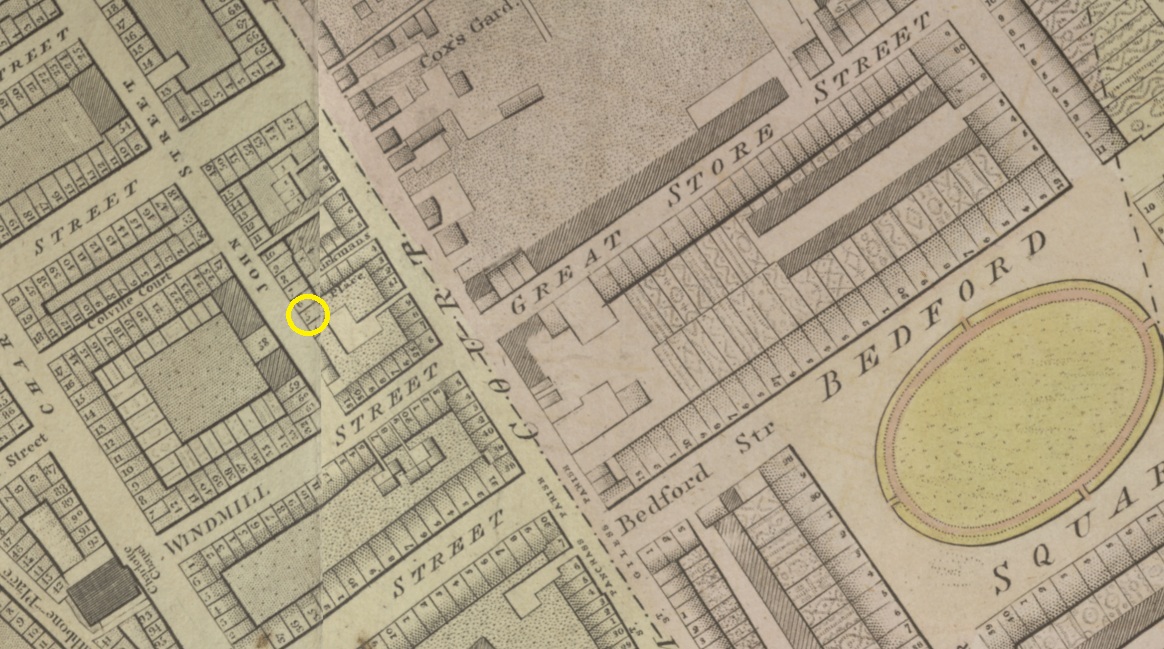
Detail from Richard Horwood’s plan of London and Westminster (1792–99), showing 5 John Street (a stone’s throw from one of my haunts—Royal Holloway’s building at 11 Bedford Square)..
Even at this late stage of research and writing, new pieces of information continue to come to light about Macintosh and his world. The latest came to my only attention yesterday by way of a reader of this blog, who was kind enough to share photographs of a letter sent from Macintosh’s son-in-law, Alexandre-Auguste Le Sueur de Colleville, to Macintosh’s brother, George, in May 1796.
Alexandre was writing from 5 John Steet (now Whitfield Street) to the west of Tottenham Court Road where he was living as an émigré with his wife, Polly, and the couple’s two young children, and possibly also Polly’s mother, Ann (who worshiped at the non-conformist chapel on Tottenham Court Road, after whose preacher, George Whitefield, John Street was later renamed).
In the letter, Alexandre explained that, having been repeatedly urged by Macintosh to join the counter-revolutionary cause, he was preparing to travel to Normandy via Jersey to join the Chouannerie, a royalist insurgency that had begun in 1793. His decision to join the insurgency appears to have been driven at least as much by financial necessity as by political conviction. He and Polly were in straitened circumstances, and Alexandre evidently hoped that, despite the risks, joining the royalist forces in France might offer him a salary or a financial bonus of some kind. As he explained to George Macintosh, this was his “last way of getting something for my family”. “I know very well that the step I am going to take is surrounded by many dangers but my situation demands a desperate remedy.”
Whether Alexandre actually made the journey is not known, but in any event he had left it rather too late. The Chouan uprising was on its last legs and a formal truce was agreed on 6 July.
I am extremely grateful for having been able to see this letter, one of the very few pieces of family correspondence that appear to have survived.
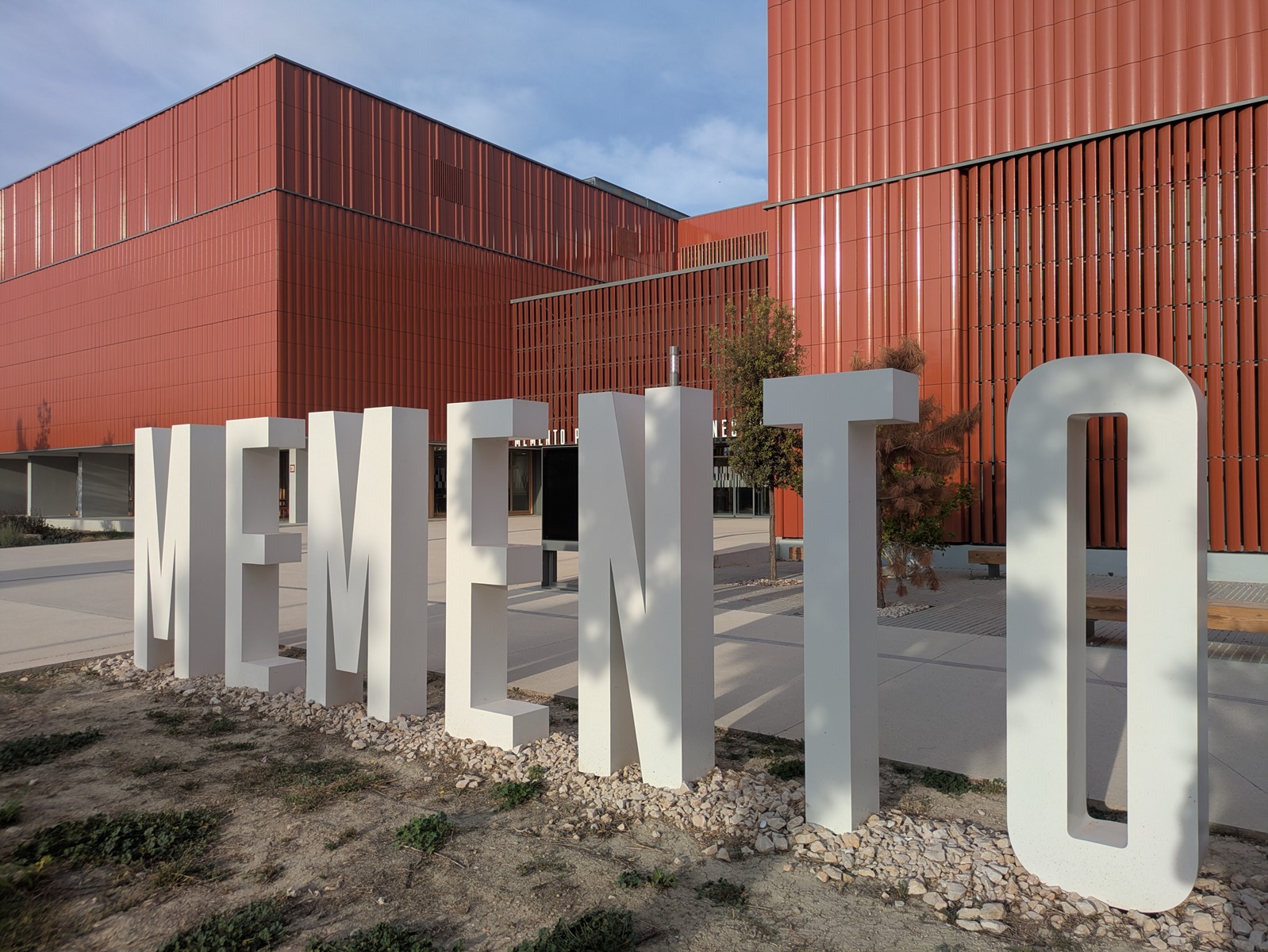
Memento. The new home to the Archives départementales de Vaucluse.
This week I have been back in Avignon in an effort to tie up the final archival loose ends that will allow me to finish the book. It’s a little more than fourteen years since I came here for the first time to scope out Macintosh’s archive. If I had known then that it would take me quite so long to make sense of it all, I may well have thrown in the towel there and then! I’m glad I didn’t know that, I’m glad that I’ve persevered, and that I’m now able to glimpse the finishing line on the horizon.
Although this was a return to a familiar collection, it was, for me, in an entirely new context, since this has been my first visit to the archive’s new home, Memento—a purpose-built facility that opened earlier this year. Although much less romantic than the archive’s old home in the Papal Palace, Memento is a much more practical venue and I certainly found it quicker and easier to order material than in the past. The only slight downside is that Memento is located on the outskirts of town, necessitating a 45-minute bus ride each way if you happen (like me) to be staying in the city centre.
Whether or not it was as a result of the move from the old to the new venue—a massive logistical operation that took the team of archivists many months to plan for and complete—the folders that comprise Macintosh’s archive have been given new and easier-to-cite archival references, meaning it will be more straightforward in the future for those who wish to consult them. For the benefit of anyone who might be interested, the updates references are as follows:
2 E 17 Fonds MAKINSTOSH [sic]
Old cote
New cote
2 E titres de famille 83
2 E 17/1
2 E Titres de famille 84
2 E 17/2
2 E Titres de famille 85
2 E 17/3
2 E Titres de famille 86
2 E 17/4
2 E Titres de famille 91/1
2 E 17/5
2 E Titres de famille 91/2
2 E 17/6
With the possible exception of one or two quick visits to the British Library and the National Archives, this will be my last phase of primary research on this project. I have only 55 working days in which to finish the book: writing, revising, and getting it into shape for submission. This is less time than I would like, and may even be less time than I need, but even the slowest of slow scholarship needs to speed up once in a while.
Archival research (or, more particularly, the search for archives) can become an obsession. The process of discovery can sometimes become an end in itself, especially for those (like myself) who are completists. This tendency has been difficult to resist in the context of this project, where I have found Macintosh lurking, often unexpectedly, in scores of archives. Notwithstanding the huge range of material I have been able to locate, there are gaps that remain stubbornly unfilled and the difficult-to-ignore suspicion that somewhere out there is another stash of letters just waiting to be found.
This suspicion was given added weight this week while I was at the National Archives looking through some documents relating to the payment of compensation to Macintosh’s daughter, Polly, for the seizure and sale of her father’s household possessions in Avignon in 1794. The documents, submitted to the Commissioners of Claims on France, include a memorial written by Polly, based on notes left to her by Macintosh, setting out her case and noting, in passing, the existence of a stash of material (letters, account books, and deeds) that Macintosh had managed to take away from Avignon before the seizure of his property.
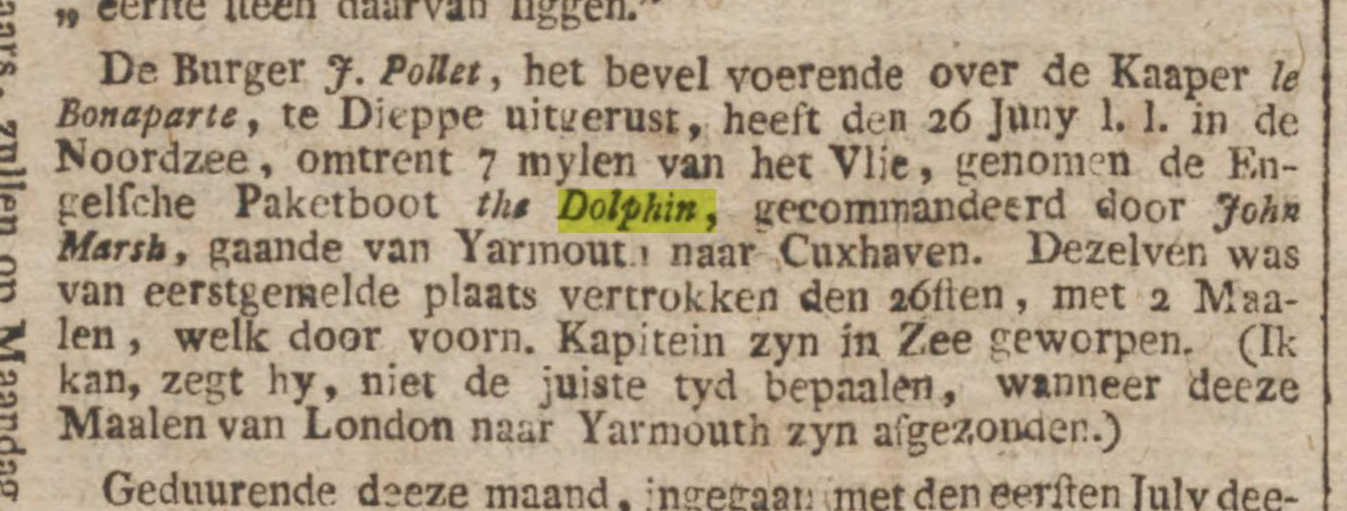
In late 1797, as the French army was approaching Bern and preparing to lay siege to the town, Macintosh, who was then living there, arranged to have these papers conveyed in a case to Britain. Three years later, now in Germany, Macintosh organised for the case to be sent from Yarmouth to Cuxhaven aboard a cross-Channel mail packet, the Dolphin. Unfortunately for Macintosh—and the crew and passengers of the Dolphin—the vessel was seized by a French privateer, Le Bonaparte, near Texel and taken into Amsterdam.
Report on the capture of the Dolphin from the Amsterdamse courant, 3 July 1800.
Although all the ship’s mail had been thrown overboard in an effort to protect its secrets, Macintosh’s case made it to Amsterdam. In an effort to get it back, Macintosh contacted the French diplomat Charles-Étienne Coquebert de Montbret, who, though he was able to confirm the existence of the case and its papers, was unable to help; the documents had by then been sent “to some of the ministers of state at Paris”. According to Polly’s memorial, Macintosh made a second attempt two years later, in June 1802, to recover the missing case, but without success.
All of this raises the tantalising possibility that sitting somewhere in an archive in Paris are Macintosh’s missing papers. My initial efforts to investigate this possibility haven’t so far led me anywhere, but I will keep persevering. Given that the Christmas deadline for the submission of my book is hovering unsettlingly on the horizon, however, my completist tendencies might well be stymied by the reality of time.
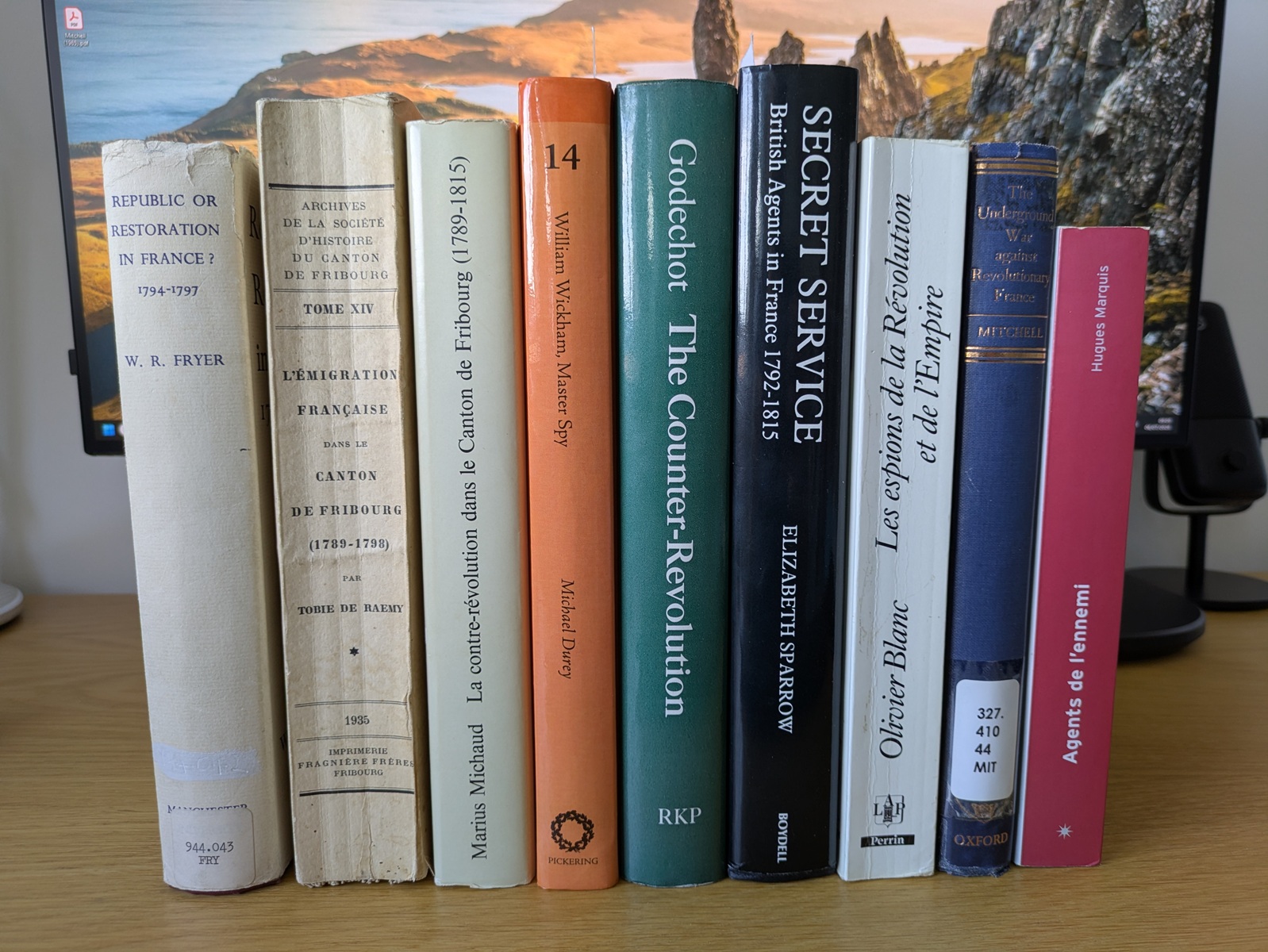
As I mentioned in my last post, I am gearing up for what will be the last substantive empirical section of the book: the chapter (and I hope it remains just one chapter) dealing with the period of Macintosh’s life from his flight from revolutionary Avignon in 1792, through his transformation into an agent of the counter-revolution as part of William Wickham’s spy ring in Switzerland, to his exile and eventual death in Eisenach in 1813.
A selection of the books on which I will depend in writing about Macintosh’s experiences as a counter-revolutionary.
As with the earlier parts of the book dealing with the Caribbean and India, beginning work on this final section feels a little like starting again from square one, since it means familiarising myself not just with an entirely new cast of characters (brought into Macintosh’s life as a consequence of his restless geographical mobility), but also a new (and very large) literature. While this process is daunting—perhaps inevitably so—it is also a great opportunity to learn.
I was reminded of this fact whilst listening to a recent episode of the wonderful podcast Drafting the Past, which featured an interview with the political scientist Anna O. Law, about her book Migration and the Origins of American Citizenship (2026). Law discussed the work involved in writing history as a non-historian, and particularly the challenges of getting to grips with both the events and the historiography in order to make a contribution to it. I felt very “seen” by her reflections on writing one particular chapter on colonial America:
So, my friend Rachel Sheldon said, you know, for us the past is a foreign country. It really was. So, for an example, the colonial chapter. Oh my god, people, please read my colonial chapter, because it took three years. One chapter took three years. Why did it take three years? Because I did two years of reading just to understand basic information before I was willing to put pen to paper. So, retraining myself as a historian meant I have to read a ton to lay down basic information, whereas a colonial historian would have probably blown through that chapter in a couple of months, not three years.
Although I lack Law’s level of dedication to the task, I entirely sympathise! I just hope this chapter doesn’t take three years.
Accidental selfie outside the Hampshire Record Office.
This week, in preparation for moving on to what will be the final empirical chapter of the book, I visited the Hampshire Record Office in Winchester to consult the correspondence of William Wickham in the vast Wickham family papers. I managed to locate two letters from Macintosh that were new to me and, in transcribing them, was faced with a familiar problem: trying to identify the individuals who were part of the constantly changing cast of characters that constituted his social and political milieux.
Although the group of people that forms the context to our lives necessarily changes across time, as new connections are formed and other fade away, Macintosh’s cosmopolitan mobility had meant that changes in the composition of his networks were often rapid and wholesale. Moving between the Caribbean, India, Britain, France, Italy, Switzerland, and Germany, Macintosh met and formed friendships with a vast and shifting cast of characters. It seems that just as I become familiar one group of individuals who populate his correspondence, he is on the move again.
I am currently dealing with Macintosh’s final days in Avignon before his flight to Switzerland (first to Estavayer and then to Bern) and preparing for yet another recomposition of his social circle. Often it is challenging simply to identify the individuals with whom he was interacting, either because of imprecise or shifting orthographies or because they are described on the basis of titles or roles shared by many others. One such that I encountered yesterday was “Young Count de Lentzbourg of Fribourg”. While a scholar of the counter-revolution in Switzerland might have been able to pinpoint this individual quite easily, the task of figuring out who’s who is more challenging when one follow an individual like Macintosh whose geographical mobility transcends specialist disciplinary knowledge.
I won’t recount the long effort and circuitious searching it took to establish that the individual to whom Macintosh was referring was Louis Stanislas Xavier de Lenzbourg (1778–1838). The two met in Bern in the year Xavier—who would go on to pursue a celebrated military career—turned seventeen and was on the lookout for a commission. Xavier is, of course, only one among scores of individuals who formed the backdrop to Macintosh’s new life as an émigré and counter-revolutionary, and I look forward (albeit with some trepidation) to meeting and getting to know this new cast of characters.
For much of the spring, I have been working to understand the social networks that defined Macintosh’s time in Avignon between the mid-1780s and early 1790s. While I have been able to trace many of the individuals whose names appear in his archive, and to understand something of their relationships with Macintosh, there are many whose presence remains obscure (at least to me). For a long time, one such figure was a child, Joseph, who appears in Macintosh’s archive in relation to his death, at the age of two, in 1788. Try as I might, I could not work out why Macintosh had documents relating to Joseph’s death—an invoice of expenses associated with the burial, and a certified extract from the parish register. Sometimes, however, all that is needed is one piece of information for everything suddenly to make sense.
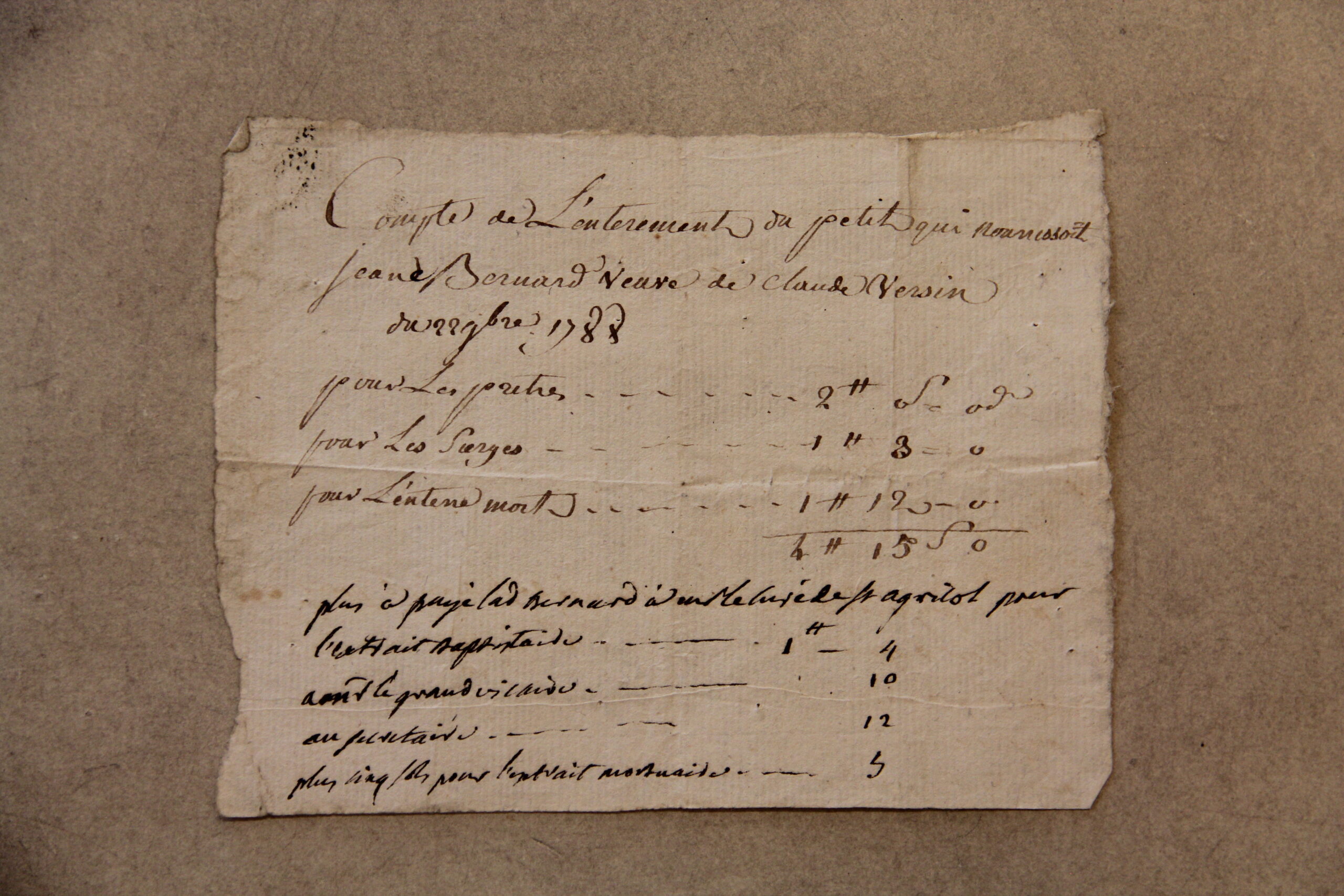
Compte de l’enterrement du petit qui nourrisoit Jeanne Bernard Veuve de Claude Versin du 22 9bre 1788. Archives départementales du Vaucluse, 2 E Titres de famille 86.
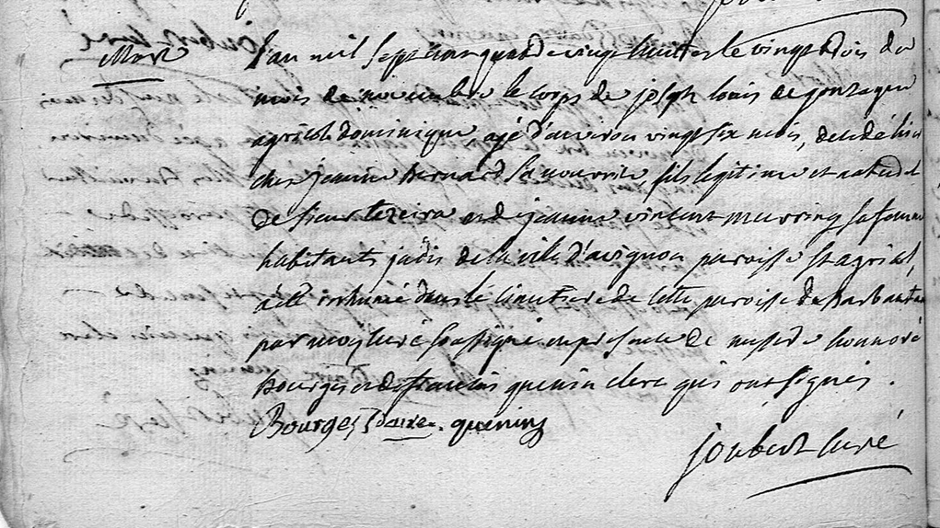
The documents in Macintosh’s archive make it clear that Joseph was about twenty-six months old when he died at the home of his wet nurse, Jeanne Bernard, on 22 November 1788. He was buried the following day in Barbentane, to the southwest of Avignon. The funeral expenses included 2 livres, 5 sols for the priest (Esprit Joubert), 1 livre, 3 sols for candles, and 1 livre, 12 sols for the interment itself.
Entry for Joseph’s burial. Archives départementales des Bouches-du-Rhône.
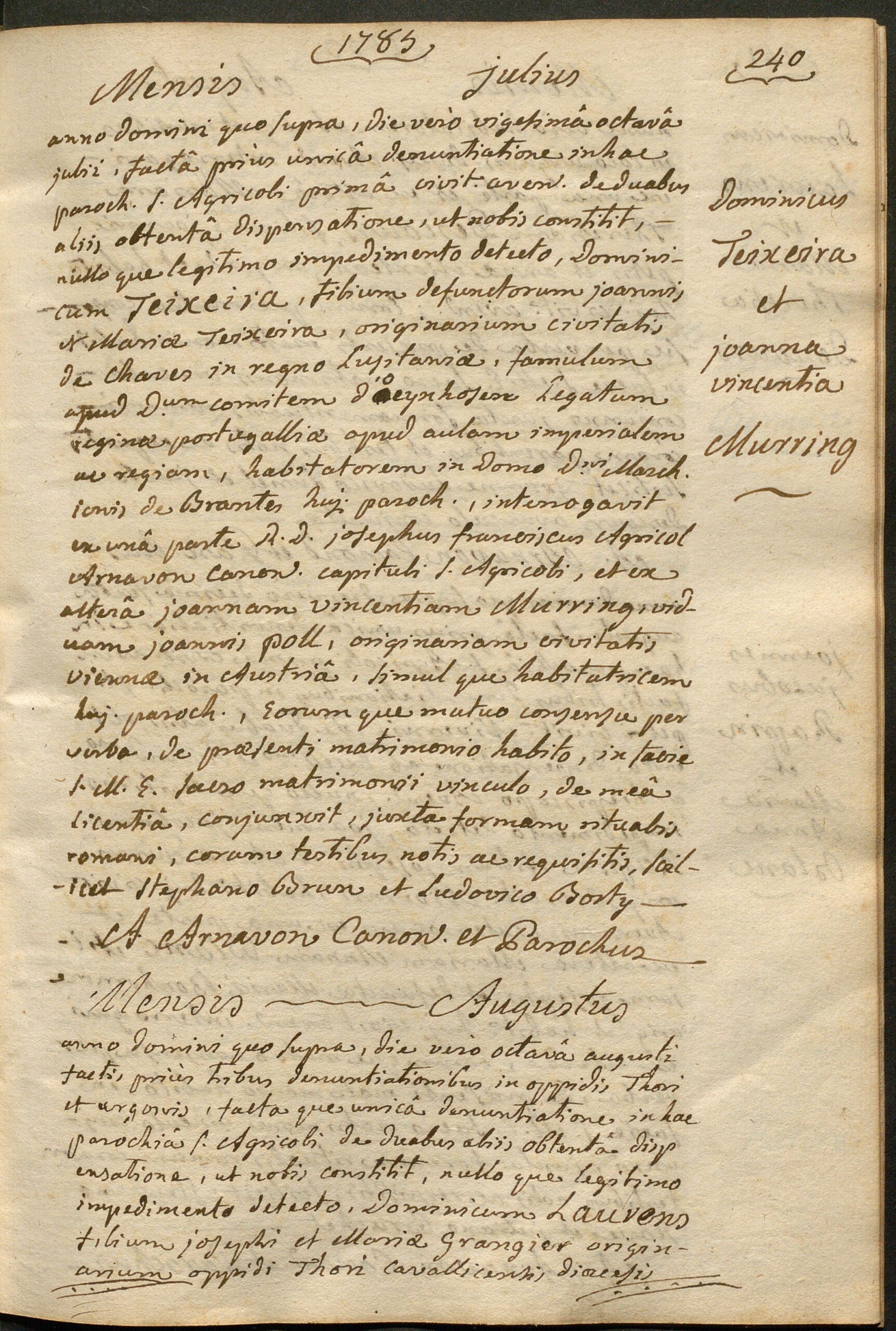
Joseph’s parents were recorded in the burial register as “le Sieur Teixeira” and “Jeanne Vincent Murring,” described as former residents of the central parish of Saint-Agricol in Avignon. Try as I might, I could not work out the connection with Macintosh until I consulted the couple’s marriage act. They had married in Avignon in the summer of 1785, and the act revealed that Teixeira was from Portugal and Murring from Vienna, and that the former was in the service of the Count of Oyenhausen-Grevenburg. Finally, I had the connection.
The marriage act for Teixeira and Murring, 28 July 1785. Archives Municipales d’Avignon, GG28, f. 240.
In 1788, Macintosh was looking after two of the Count’s children at his home outside Avignon while the Count and Countess were in Portugal. It seems likely that Teixeira and Murring had gone with them, leaving Joseph in the care of a wet nurse in Barbentane. Joseph’s death—which would have been a devastating blow to his parents on their return to Avignon—would have required Macintosh to step in and cover the expenses in the meantime. At the same time, the Count and Countess’s youngest child, Henriqueta, was being cared for by another wet nurse at Macintosh’s home.
While this story may end up as a footnote to a footnote, I find it impossible not to be fascinated by these connections, obligations, and unconsidered lives. If Macintosh deserves to be remembered, then so too does Joseph.
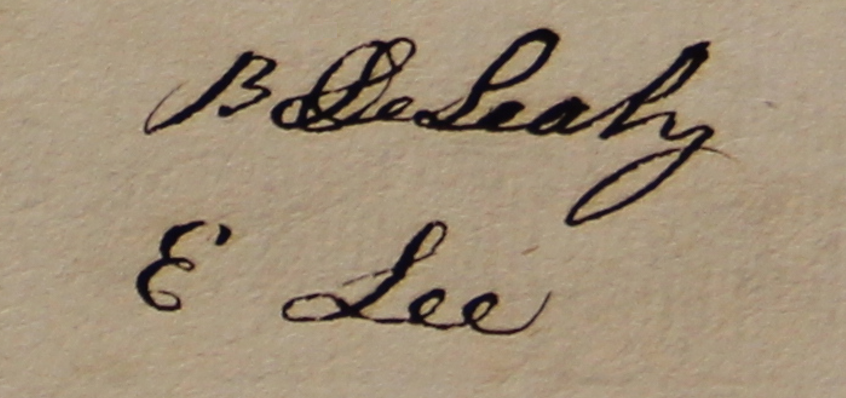
I have noted more than once on this blog that, despite having spent so many years trying to understand Macintosh’s world, there are some elements that remain stubbornly obscure. One such is the identity and role of two women who formed part of Macintosh’s household throughout his time in Avignon and later exile in Switzerland: B. Deleahy and E. Lee. I have long known that these women existed (their names appear often on receipts and invoices, for example), and I was aware that as I grew closer to writing about Macintosh’s time in Avignon I would eventually have to try to figure out who they were and what they were doing in his life.
Both women first appear in Macintosh’s archive in 1782, when they were living in Liège and had assumed—at least in the case of Deleahy—the role of guardian for Macintosh’s youngest daughter, Polly, during an 18-month stay on the Continent. How Macintosh had come to meet these women is currently unclear, as is almost everything else about them.
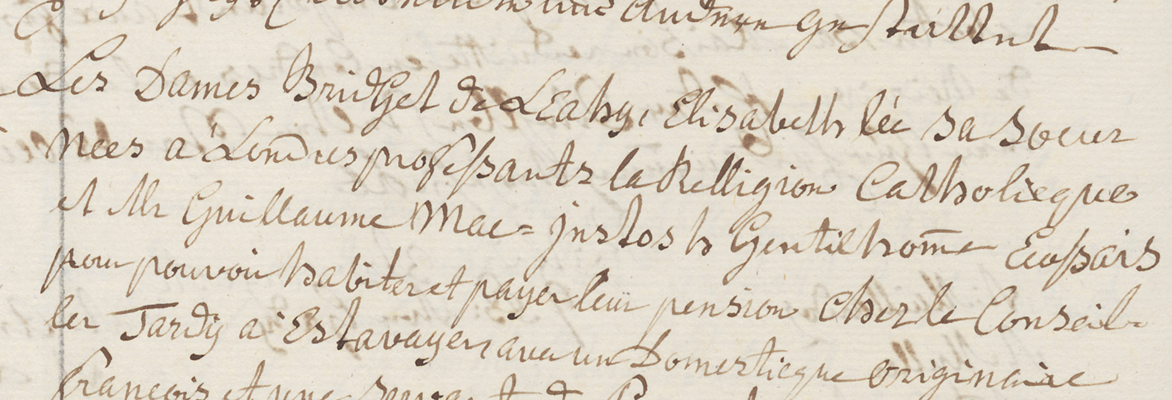
Following a lead I found in the 1935 book L‘Émigration Francaise dans le Canton de Fribourg (1789–1798), I was able to locate Deleahy and Lee in the Archives de l’Etat de Fribourg, where they appear (alongside Macintosh) in the Rathsmanual of the canton’s Petit Conseil—recent émigrés from France. The entry is extremely revealing; it gives the women’s first names (Bridget and Elizabeth, respectively), their religion (Catholic), and their place of birth (London).
Extract from the Manuaux du Petit Conseil de Fribourg for 3 August 1792. Archives de l’Etat de Fribourg, CH AEF RM 343 (année 1792), f. 410.
The entry in the Rathsmanual concerns the sisters’ request to take up lodgings with Macintosh and their two servants in Estavayer, on the southern shore of Lake Neuchâtel. The Petit Conseil approved their request, but vetoed one of the servants, who was French. At this time there was a widespread concern that working-class French citizens posed a risk of spreading revolutionary sentiments in Switzerland.
Having Bridget and Elizabeth’s names is a helpful starting point, but there is a great deal more digging to do. I have found a reference to them both in a biography of the German novelist Sophie von La Roche that appears to connect them to the Catholic community of Frankfurt. I can see a new rabbit hole ahead…
Today marks this blog’s 14th birthday. A great deal has happened since my first post in 2012, when I was just beginning to figure out who William Macintosh was and how interesting (and challenging) it might be to piece together the story of his life. Thanks to the largess of the British Academy, I have been working full time on my book since the beginning of September and have managed to make the kind of progress that I know would almost certainly be impossible under other circumstances. As ever, however, there is still a long way to go, but I am beginning to sense a glimmer of light at the end of the tunnel (or at least the tunnel that leads to a first complete draft of my book; there will doubtless be another long tunnel that leads to a revised and shortened version suitable to submit to the press!).
I have recently begun work on the book’s tenth chapter, which follows a decade in Macintosh’s life from financial failure in London in 1783, through personal reinvention as a gentleman farmer in the rural hinterland of Avignon and the tragic suicide of his son, to the advent of the French Revolution and the eventual seizure of his property as a bien national. I am looking forward (albeit trepidatiously) to tackling this chapter, since it concerns the period of Macintosh’s life that is currently the most obscure to me. Part of the mystery derives from the fact that most of the archival sources are (understandably) written in French and therefore take me much longer to process and make sense of than English-language sources.
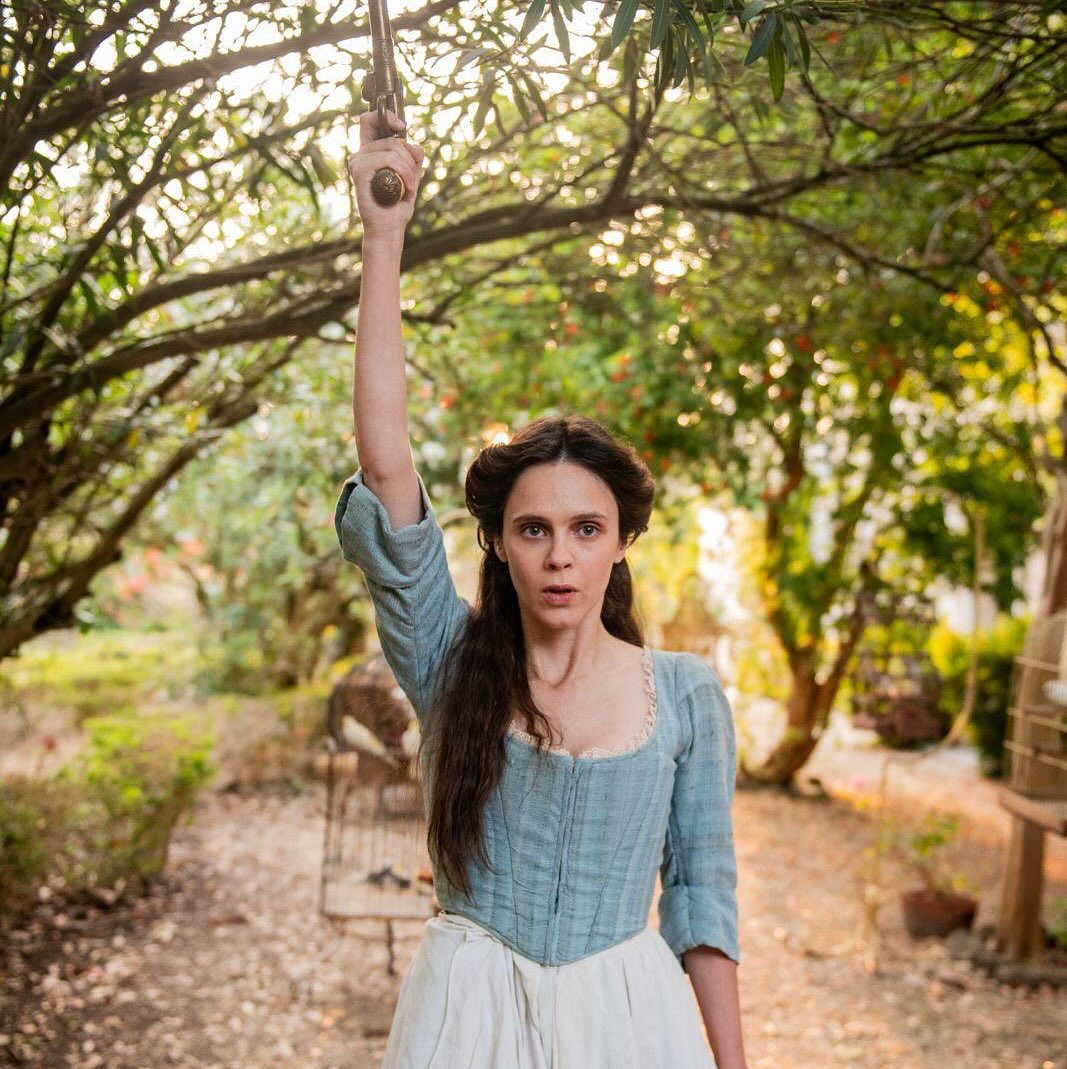
One episode of Macintosh’s time in France that I am particularly looking forward to unravelling is his friendship with Leonor de Almeida Portugal, the poet and painter whom Macintosh knew as the Countess Oyenhausen. Leonor, Marquesa de Alorna, led a fascinating life that rivals Macintosh for interest and intrigue. Indeed, so compelling is her story that it will be coming to Netflix later this year as a six-part Portuguese-language biographical series made by Ukbar Filmes and RTP, with Sara Matos in the lead role.
Looking ahead to next year and this blog’s fifteenth birthday, I should by then have submitted the book manuscript and will be waiting (again with trepidation) for the arrival of the reviewers’ reports. Perhaps then I can start writing the script for the six-part Netflix series!
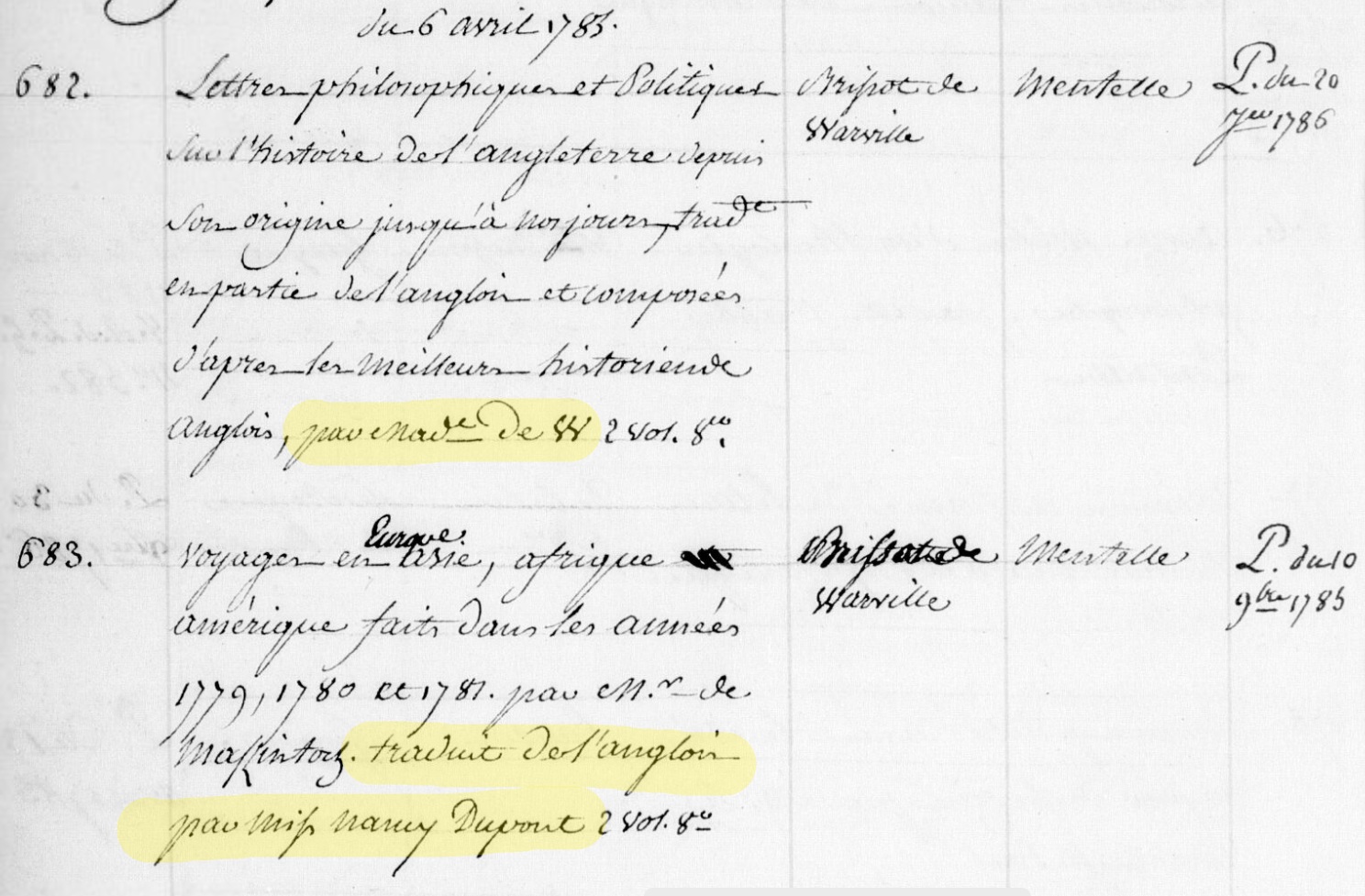
Today is International Women’s Day and a good time to discuss the forgotten work that went into making the French translation of Macintosh’s Travels, published in Paris as Voyages en Europe, Asie et en Afrique (1786). Although the translation was (and is) typically attributed to Jacques-Pierre Brissot, the reality is rather more complicated and interesting. It has long been known that Brissot’s wife, Félicité, was responsible (either alone or in collaboration with her husband) for a number of translations ordinarily attributed to him. The question of whether Félicité had undertaken, or assisted with, the translation of Macintosh’s book is one that I have only recently been able to answer, thanks to the digitised records of the archive of the Paris book guild, the Chambre syndicale de la librairie et imprimerie de Paris.
In April 1785, Voyages was registered with the guild and subsequently issued with a permission tacite (tacit permission), allowing it to be published and distributed. As part of the registration process, the book’s translator was named. Here, the register took me by surprise: not only was the translation not Brissot’s, it was not Félicité’s either. The real translator was, in fact, Félicité’s teenage sister, Marie-Anne, known in the family as Nancy.
Extract from the Registres des permissions tacites commencé le 1 Mai 1782 a 1788, Bibliothèque nationale de France, Français 21986, f. 126. Showing the translator of “Travels”/”Voyages” as Miss Nancy Dupont, and the translator of “Lettres philosophiques” as Félicité, Mad[am]e de W[arville].
At the time the translation was undertaken (somewhere between the autumn of 1783 and the spring of 1784), Nancy was living in London with her sister and brother-in-law, who had relocated there from France in order to pursue Brissot’s dream of establishing a new literary and philosophical society, the Lycée de Londres. At this time, Brissot was busily engaged in various publishing ventures, including the six-part periodical Tableau de la situation actuelle des Anglois dans les Indes Orientales. Brissot had encountered Macintosh’s book as part of the wider research that supported the composition of the Tableau, and decided at some point in 1783 that a full-scale French translation was required as a supplement of sorts to the Tableau. Félicité, who might ordinarily have performed the literary labour of translation was occupied with a different task: translating and adapting Oliver Goldsmith’s An History of England, in a Series of Letters from a Nobleman to his Son (1764), subsequently published in Paris in 1786 as Lettres philosophiques et politiques sur l’histoire de l’Angleterre. The task of translating Travels was, therefore, taken on by Nancy, in the year she turned sixteen.
Travels was a long book (around 150,000 words) and full of references to places and people with whom Nancy was probably unfamiliar. This was not, then, an insignificant undertaking, but it would have been done with the support of Félicité and in close consultation with Brissot, who took on a more editorial role in the production of Voyages—supplementing the book with a preface and footnote commentary, as well as emending the text in some places, expanding it in others, and clarifying it elsewhere. Even with support, Nancy’s task was substantial and challenging, but she clearly possessed the skill and capacity to do it. Brissot would later tell his Swiss publishers, the Société typographique de Neuchâtel, that he was très content with they way the translation had turned out.
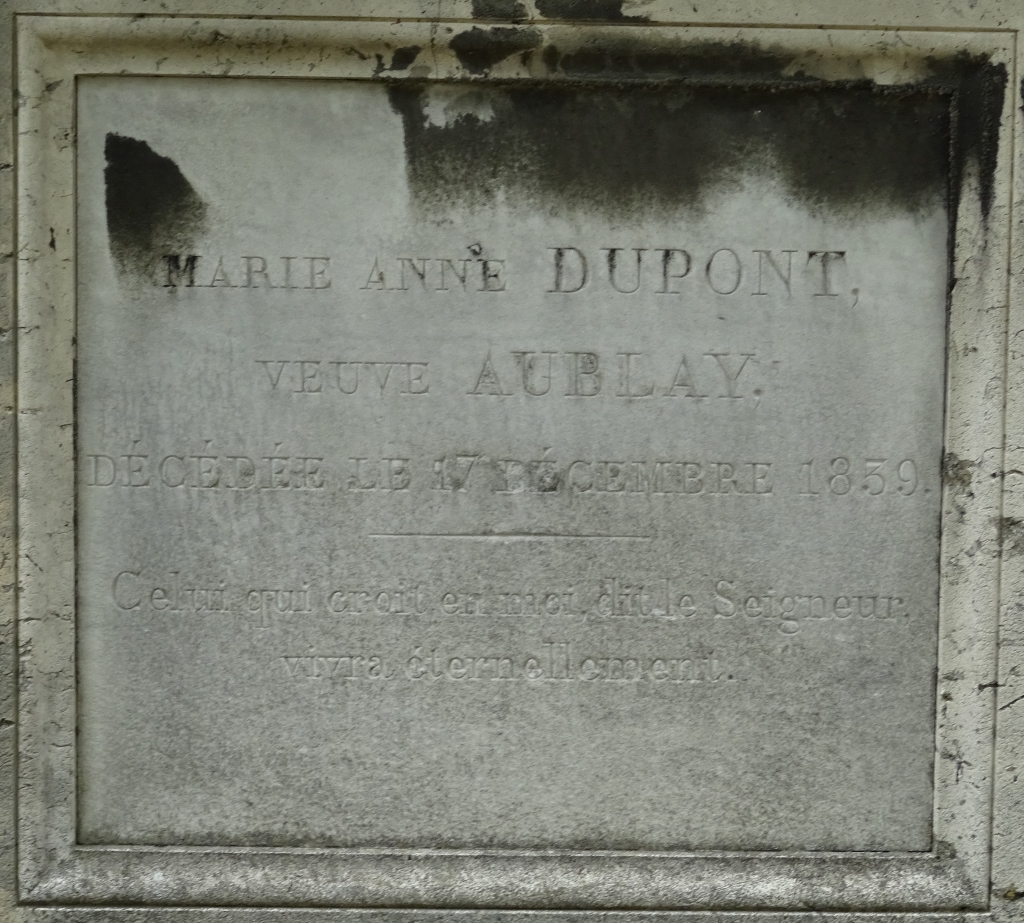
Nancy’s subsequent life was eventful, but obscure in the historiography. She went on to marry Edme-Pierre Aublay, lived for a time in Philadelphia, ran a small boarding school (first on Cherry Street in Birmingham and then on Russel Square in London), endured the tragic death of her son, Francis (or François), an undergraduate student at the University of Oxford, corresponded with Joseph Banks, dedicated a book of religious instruction to her grand nephews, Felix and Eugene, invoking their learned grandfather, Jacques-Pierre, found herself one day captivated by the religious writing of Sir Matthew Hale, and died on the rue Saint-Honoré in Paris in December 1839, aged seventy-three. She was buried in the Père Lachaise cemetery.
Nancy’s labour on Voyages would have remained entirely invisible were it not for one line in the registers of the Paris book guild. I’m just glad I found it!
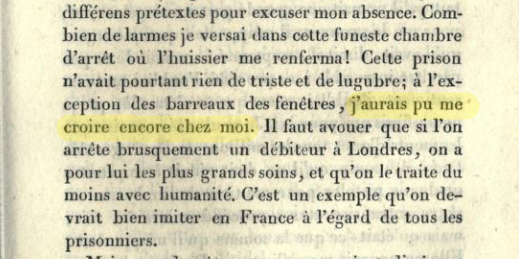
1784 was a particularly unfortunate year in the life of Jacques-Pierre Brissot. It would see him imprisoned twice: once in London (over unpaid printer’s bills) and once Paris (over his alleged involvement in the production of libellous pamphlets). It was also the year that he, possibly in collaboration with his wife, Félicité, completed the French translation of Macintosh’s Travels. In attempting to understand the events of that year, I was curious to know where it was in London that Brissot had been incarcerated. Most secondary sources identify it simply as a “debtors’ prison”, of which there were several in London at the time. Brissot, in his Mémoires, does not specify the name or location of the prison, but notes that, apart from the bars on the window, his surroundings were almost domestic: “I could have believed I was still at home [j’aurais pu me croire encore chez moi].”
Brissot’s account of his imprisonment from his Mémoires (1830, vol. 2, 301)
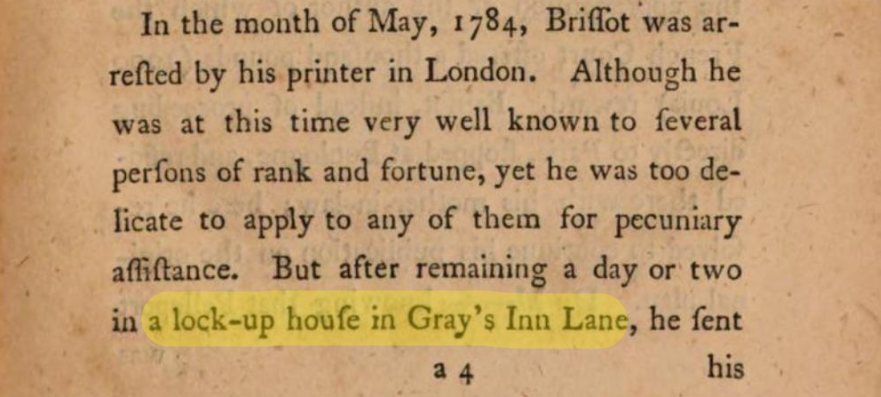
The closest to a contemporary source I have been able to find—a brief biography of Brissot, written by Joel Barlow to accompany his 1794 English translation of one of Brissot’s works—is a little more specific, describing the prison as “a lock-up house in Gray’s Inn Lane.”
Although Barlow’s sketch of Brissot’s life has been described as “fanciful” by Robert Darnton in The Literary Underground of the Old Regime (1982), the specificity of the information with respect to Brissot’s incarceration perhaps lends it some credibility. Rather than a debtors’ prison per se, the lock-up on Gray’s Inn Lane (now Gray’s Inn Road) was a so-called sponging-house (sometimes spunging), where debtors were held temporarily in the expectation that a quick agreement could be reached with their creditors—see Margot Finn,The Character of Credit: Personal Debt in English Culture, 1740–1914 (2003), 116–17. This was the case for Brissot, who, thanks to the financial assistance of friends and his mother-in-law, was able to extricate himself after a few days.
If we consider Barlow to be accurate, the lock-up in question was a public house, the Pied Bull (or Py’d or Pyed). In 1786, not long after Brissot’s incarceration, the pub was insured by its then landlord, John Smith. We can, perhaps, suppose that Smith was also in charge at the time of Brissot’s arrest in May 1784. Obviously none of this really matters, and certainly has no particular bearing on Brissot’s translation of Travels, but I am always curious about how we know what we know about the past, and that it seems that, in the context of the first of Brissot’s 1784 imprisonments, what we know (or, at least, what appears in the secondary literature) is a little imprecise. Rather than disappear down that rabbit hole myself (I am sure there are archival records that could definitively identify the site of Brissot’s incarceration), I hope this post might encourage others better placed that me to throw some light on that question.