Monthly Archives: February 2026

The forgotten labour of Nancy Dupont

Today is International Women’s Day and a good time to discuss the forgotten work that went into making the French translation of Macintosh’s Travels, published in Paris as Voyages en Europe, Asie et en Afrique (1786). Although the translation was (and is) typically attributed to Jacques-Pierre Brissot, the reality is rather more complicated and interesting. It has long been known that Brissot’s wife, Félicité, was responsible (either alone or in collaboration with her husband) for a number of translations ordinarily attributed to him. The question of whether Félicité had undertaken, or assisted with, the translation of Macintosh’s book is one that I have only recently been able to answer, thanks to the digitised records of the archive of the Paris book guild, the Chambre syndicale de la librairie et imprimerie de Paris.
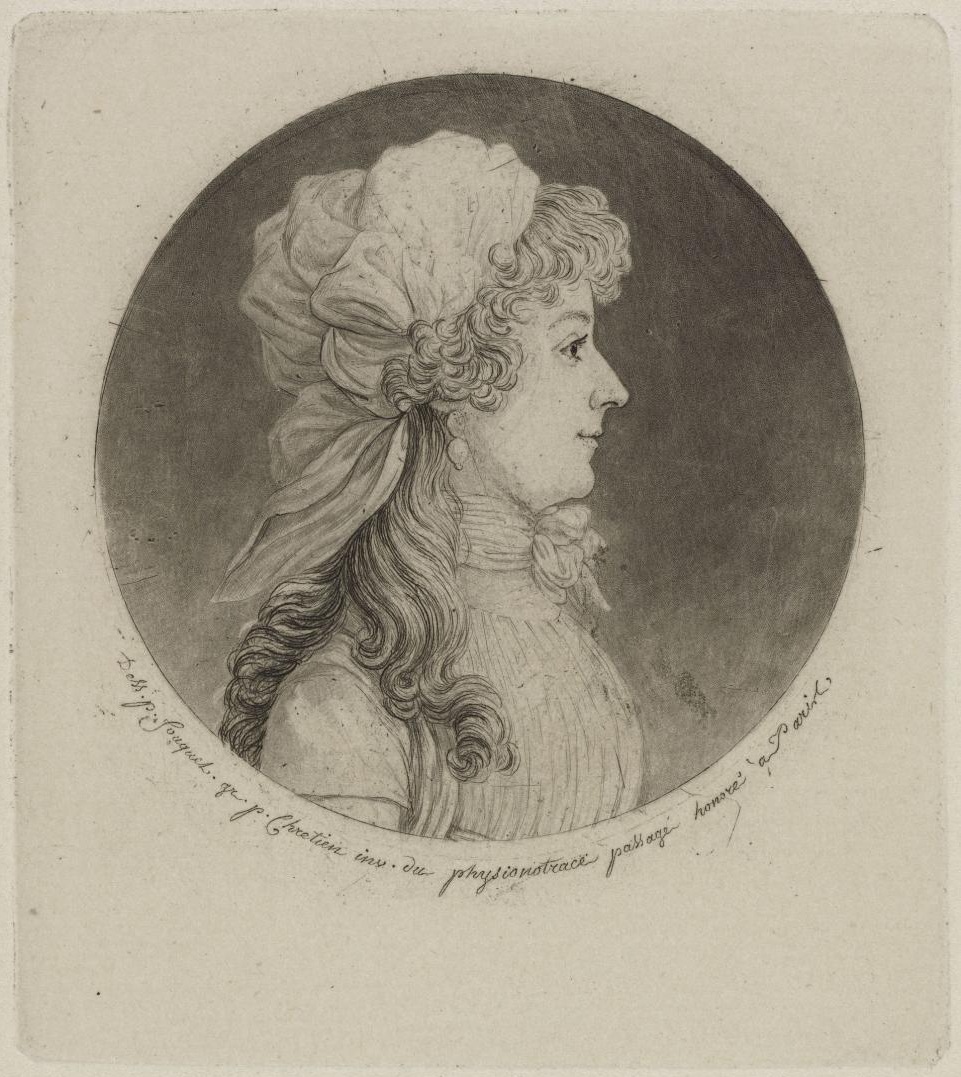
Portrait of Félicité Brissot de Warville (née Dupont), engraved by Gilles-Louis Chrétien (c. 1792).© Musée Carnavalet, Histoire de Paris,G.20819-6.

In April 1785, Voyages was registered with the guild and subsequently issued with a permission tacite (tacit permission), allowing it to be published and distributed. As part of the registration process, the book’s translator was named. Here, the register took me by surprise: not only was the translation not Brissot’s, it was not Félicité’s either. The real translator was, in fact, Félicité’s teenage sister, Marie-Anne, known in the family as Nancy.
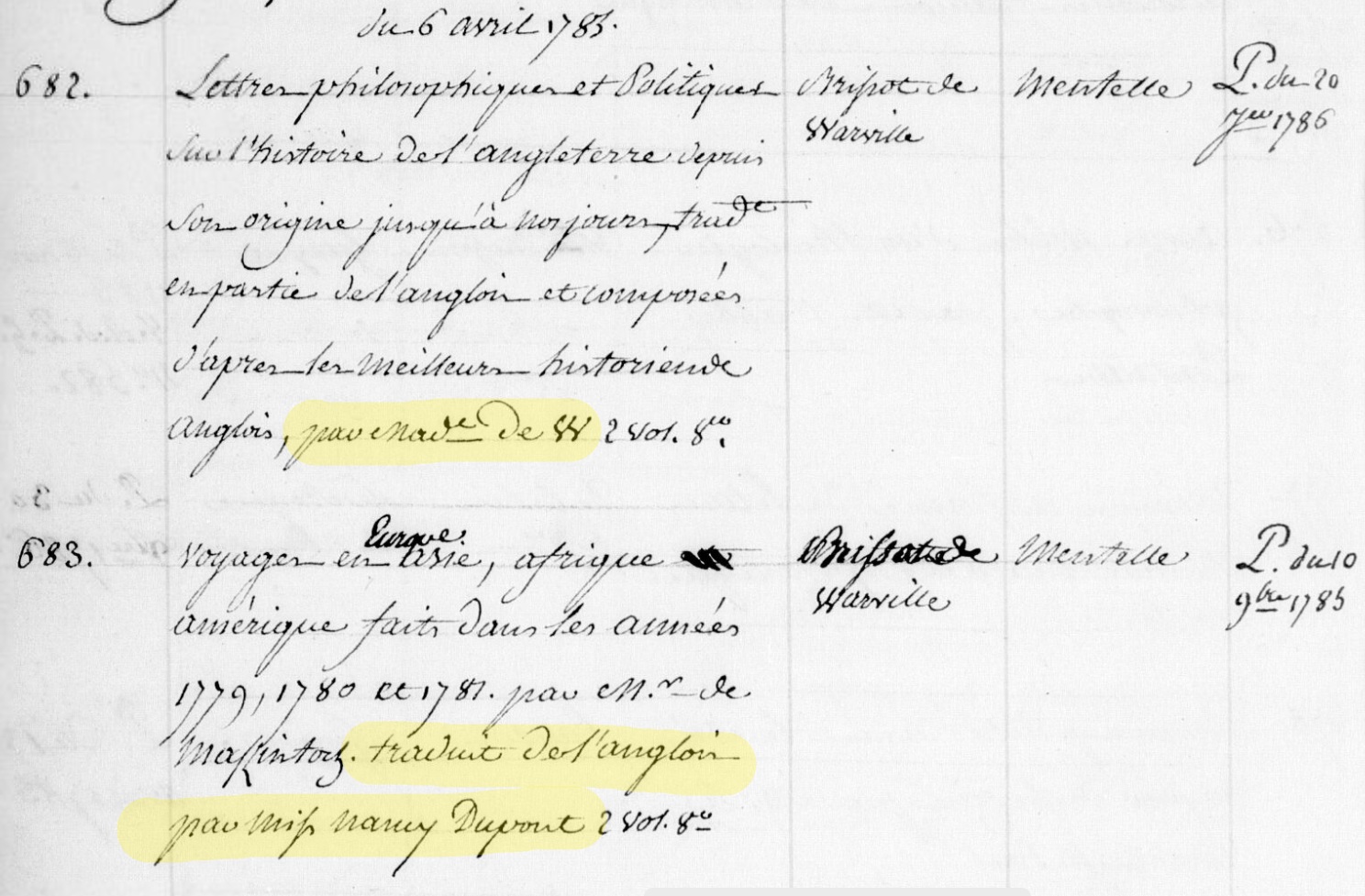
Extract from the Registres des permissions tacites commencé le 1 Mai 1782 a 1788, Bibliothèque nationale de France, Français 21986, f. 126. Showing the translator of “Travels”/”Voyages” as Miss Nancy Dupont, and the translator of “Lettres philosophiques” as Félicité, Mad[am]e de W[arville].

At the time the translation was undertaken (somewhere between the autumn of 1783 and the spring of 1784), Nancy was living in London with her sister and brother-in-law, who had relocated there from France in order to pursue Brissot’s dream of establishing a new literary and philosophical society, the Lycée de Londres. At this time, Brissot was busily engaged in various publishing ventures, including the six-part periodical Tableau de la situation actuelle des Anglois dans les Indes Orientales. Brissot had encountered Macintosh’s book as part of the wider research that supported the composition of the Tableau, and decided at some point in 1783 that a full-scale French translation was required as a supplement of sorts to the Tableau. Félicité, who might ordinarily have performed the literary labour of translation was occupied with a different task: translating and adapting Oliver Goldsmith’s An History of England, in a Series of Letters from a Nobleman to his Son (1764), subsequently published in Paris in 1786 as Lettres philosophiques et politiques sur l’histoire de l’Angleterre. The task of translating Travels was, therefore, taken on by Nancy, in the year she turned sixteen.

Travels was a long book (around 150,000 words) and full of references to places and people with whom Nancy was probably unfamiliar. This was not, then, an insignificant undertaking, but it would have been done with the support of Félicité and in close consultation with Brissot, who took on a more editorial role in the production of Voyages—supplementing the book with a preface and footnote commentary, as well as emending the text in some places, expanding it in others, and clarifying it elsewhere. Even with support, Nancy’s task was substantial and challenging, but she clearly possessed the skill and capacity to do it. Brissot would later tell his Swiss publishers, the Société typographique de Neuchâtel, that he was très content with they way the translation had turned out.

Nancy’s subsequent life was eventful, but obscure in the historiography. She went on to marry Edme-Pierre Aublay, lived for a time in Philadelphia, ran a small boarding school (first on Cherry Street in Birmingham and then on Russel Square in London), endured the tragic death of her son, Francis (or François), an undergraduate student at the University of Oxford, corresponded with Joseph Banks, dedicated a book of religious instruction to her grand nephews, Felix and Eugene, invoking their learned grandfather, Jacques-Pierre, found herself one day captivated by the religious writing of Sir Matthew Hale, and died on the rue Saint-Honoré in Paris in December 1839, aged seventy-three. She was buried in the Père Lachaise cemetery.
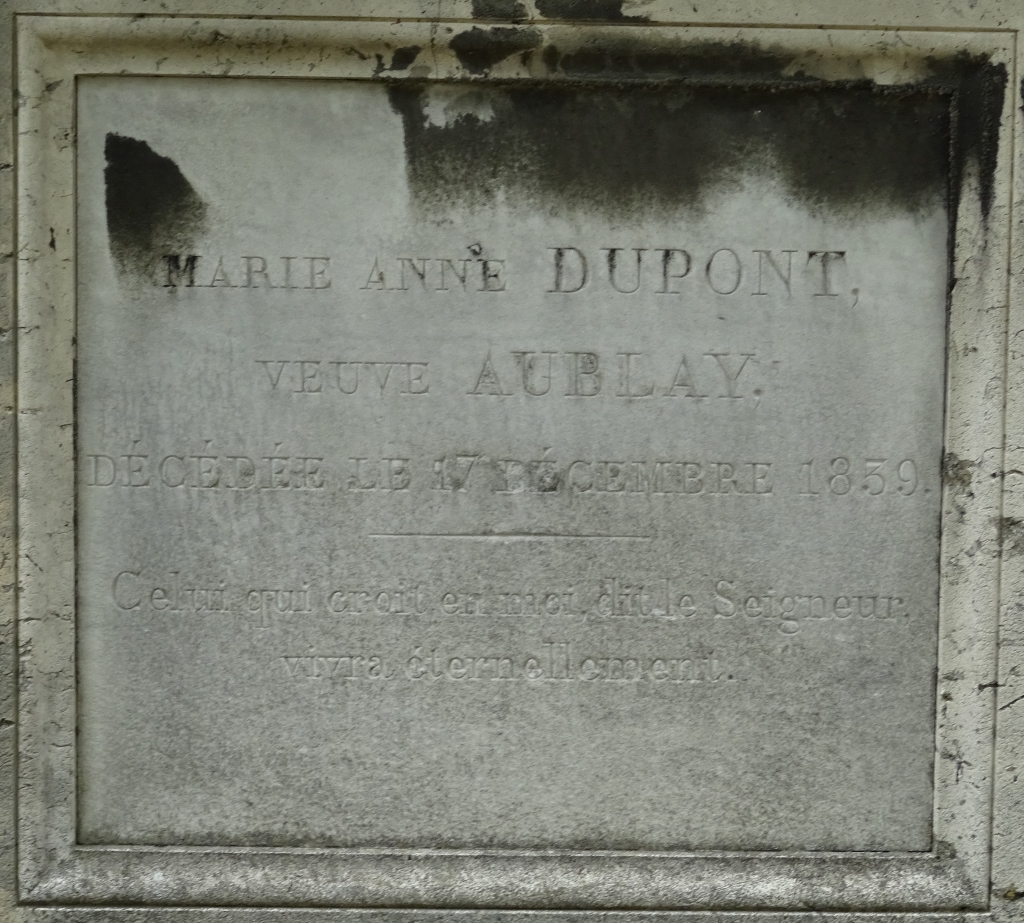
The inscription to Nancy on the family monument in the Père Lachaise cemetery. © Amis et Passionnés du Père Lachaise.

Nancy’s labour on Voyages would have remained entirely invisible were it not for one line in the registers of the Paris book guild. I’m just glad I found it!
Jacques-Pierre Brissot in the Sponging House

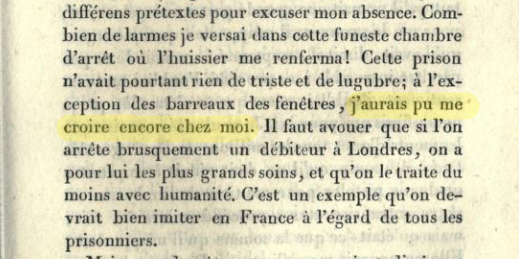
1784 was a particularly unfortunate year in the life of Jacques-Pierre Brissot. It would see him imprisoned twice: once in London (over unpaid printer’s bills) and once Paris (over his alleged involvement in the production of libellous pamphlets). It was also the year that he, possibly in collaboration with his wife, Félicité, completed the French translation of Macintosh’s Travels. In attempting to understand the events of that year, I was curious to know where it was in London that Brissot had been incarcerated. Most secondary sources identify it simply as a “debtors’ prison”, of which there were several in London at the time. Brissot, in his Mémoires, does not specify the name or location of the prison, but notes that, apart from the bars on the window, his surroundings were almost domestic: “I could have believed I was still at home [j’aurais pu me croire encore chez moi].”

Brissot’s account of his imprisonment from his Mémoires (1830, vol. 2, 301)

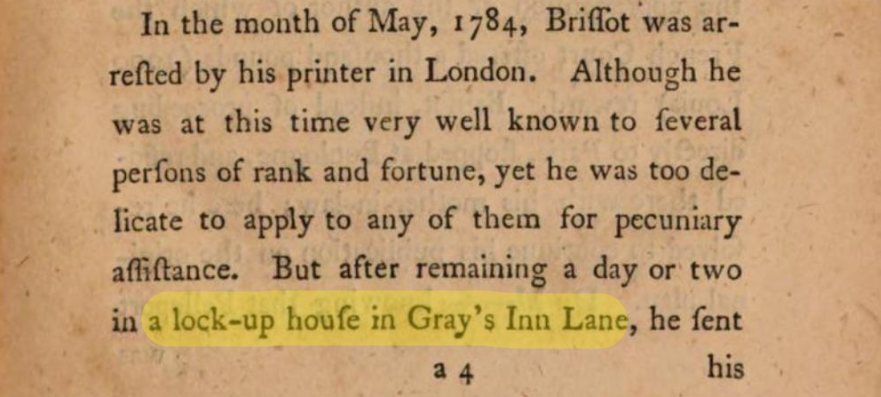
The closest to a contemporary source I have been able to find—a brief biography of Brissot, written by Joel Barlow to accompany his 1794 English translation of one of Brissot’s works—is a little more specific, describing the prison as “a lock-up house in Gray’s Inn Lane.”

Extract from Joel Barlow’s anonymous “A Sketch of the Life of J. P. Brissot” from his translation, New Travels in the United Skates of America: Including the Commerce of America with Europe […] 2 vols. (London: Printed for J. S. Jordan, 1794), vol. 2, vii.

Although Barlow’s sketch of Brissot’s life has been described as “fanciful” by Robert Darnton in The Literary Underground of the Old Regime (1982), the specificity of the information with respect to Brissot’s incarceration perhaps lends it some credibility. Rather than a debtors’ prison per se, the lock-up on Gray’s Inn Lane (now Gray’s Inn Road) was a so-called sponging-house (sometimes spunging), where debtors were held temporarily in the expectation that a quick agreement could be reached with their creditors—see Margot Finn,The Character of Credit: Personal Debt in English Culture, 1740–1914 (2003), 116–17. This was the case for Brissot, who, thanks to the financial assistance of friends and his mother-in-law, was able to extricate himself after a few days.

If we consider Barlow to be accurate, the lock-up in question was a public house, the Pied Bull (or Py’d or Pyed). In 1786, not long after Brissot’s incarceration, the pub was insured by its then landlord, John Smith. We can, perhaps, suppose that Smith was also in charge at the time of Brissot’s arrest in May 1784. Obviously none of this really matters, and certainly has no particular bearing on Brissot’s translation of Travels, but I am always curious about how we know what we know about the past, and that it seems that, in the context of the first of Brissot’s 1784 imprisonments, what we know (or, at least, what appears in the secondary literature) is a little imprecise. Rather than disappear down that rabbit hole myself (I am sure there are archival records that could definitively identify the site of Brissot’s incarceration), I hope this post might encourage others better placed that me to throw some light on that question.

Macintosh, Washington, and Goethe’s birthday present

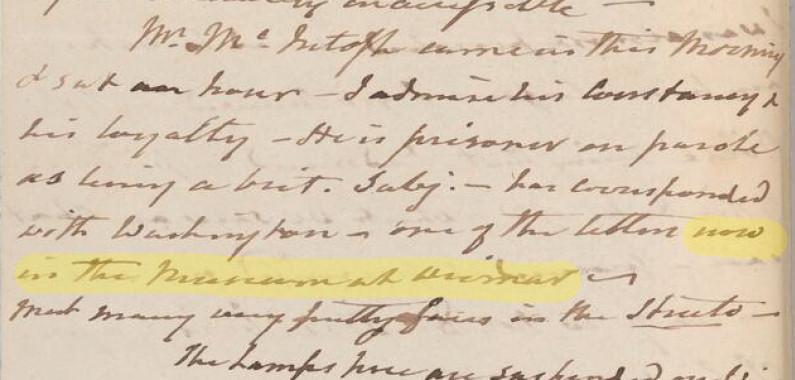
Long-time readers of this blog will know that I have been trying for some time to understand the journey of one of Macintosh’s letters from George Washington, originally received by him in Avignon in 1788. When, twenty-two years later, Aaron Burr met Macintosh in Eisenach, Burr recorded in his journal that the letter from Washington was “now in the museum at Weimar.”

Extract from Aaron Burr’s journal for 15 January 1810 (Huntington Library, mssHM 844, f. 503).

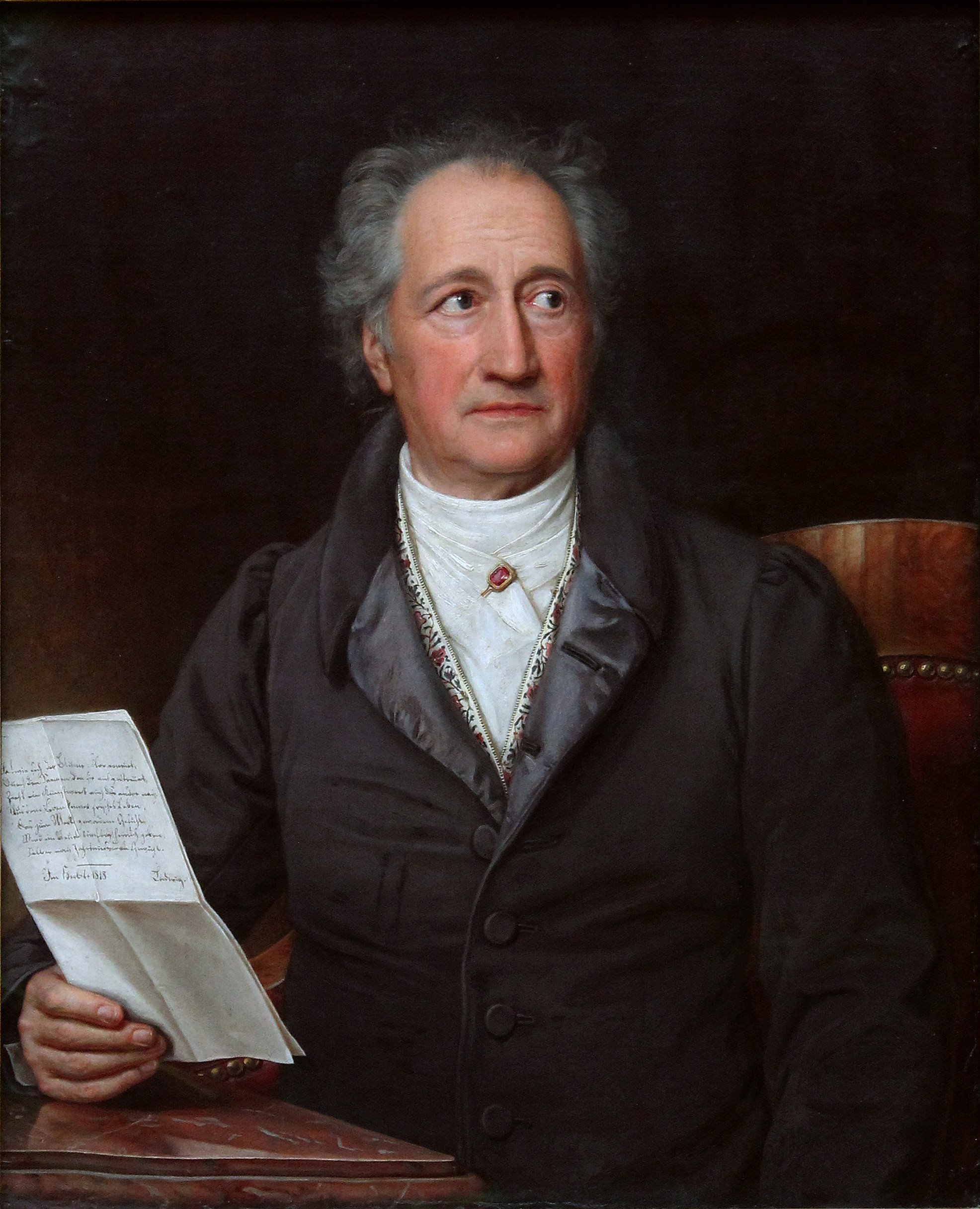
In late 2024, with the kind assistance of Dominik Hünniger, I traced the letter to the Goethe- und Schiller-Archiv in Weimar. Subsequent investigation revealed that the letter had previously been part of Goethe’s large collection of autographs and, more recently, had been on display a number of times at the Goethe- und Schiller-Archiv as one of its archival treasures.

Portrait of Johann Wolfgang von Goethe, by Joseph Karl Stieler (1828). © Bayerische Staatsgemäldesammlungen – Neue Pinakothek, WAF 1048.

Two questions remained: 1) How did the letter come into Goethe’s possession? and 2) In which museum had it been displayed when Macintosh and Burr discussed it in 1810?

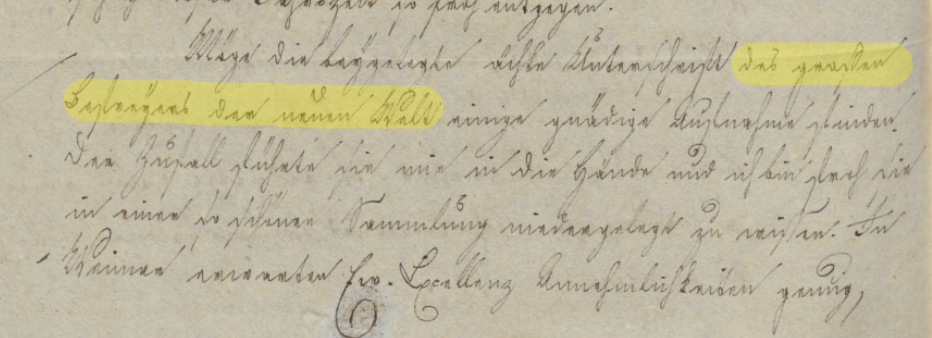
The answer to the first question comes (at least in part) from a letter to Goethe from his secretary-librarian Friedrich Theodor David Kräuter. Dated 28 August 1818, Goethe’s sixty-ninth birthday, Kräuter’s letter enclosed a much-wished-for addition to Goethe’s autograph collection: “the authentic signature of the great liberator of the New World [die beygelegte ächte Unterschrift des großen Befreyers der neuen Welt].” Although Kräuter does not mention Washington by name, it is highly likely that this is who he was referring to. Kräuter goes on to explain that he stumbled upon the letter containing Washington’s signature simply by chance.

Detail of Kräuter’s letter to Goethe. Goethe- und Schiller-Archiv, 28/79, Bl 533-534.

In attempting to answer the second unresolved question, I received some very helpful advice from Sabine Schäfer at the Goethe- und Schiller-Archiv. She was able to point me towards a source—Goethes “Bildergalerie”: Die Anfänge der Kunstsammlungen zu Weimar (2002)—that details a short-lived museum that was established in 1809 in the Fürstenhaus on Fürstenplatz (now Platz der Demokratie) where the family of Karl August, Duke of Saxe-Weimar-Eisenach lived. The four-room museum displayed a variety of artworks and, so it would seem, Macintosh’s letter from Washington.

The museum closed in January 1811 and the paintings (and the letter) were moved to the ducal library. The following year, one of Goethe’s friends and colleagues, Christian Gottlob von Voigt, who, with Goethe, was responsible for overseeing the library, wrote to him to explain that he had long intended to give the Washington letter to Goethe, but had been unable to find it among the chaos of his papers. Months later, Voigt was still unable to locate it.

So, now we know (or can be reasonably confident) that Macintosh’s letter from Washington was on display in the museum in the Fürstenhaus in 1810, that it was subsequently transferred to the ducal library, thereafter was lost or mislaid, then found its way to Kräuter, before becoming a memorable gift for Goethe’s sixty-nineth birthday.

As is often the case with this project, answering one question inevitably raises others. How did the letter come to be in the museum in the first place? Did Macintosh donate it to von Voigt directly? Did he hope that the letter might secure him some social capital? As ever, there is more digging to do!