
Today is International Women’s Day and a good time to discuss the forgotten work that went into making the French translation of Macintosh’s Travels, published in Paris as Voyages en Europe, Asie et en Afrique (1786). Although the translation was (and is) typically attributed to Jacques-Pierre Brissot, the reality is rather more complicated and interesting. It has long been known that Brissot’s wife, Félicité, was responsible (either alone or in collaboration with her husband) for a number of translations ordinarily attributed to him. The question of whether Félicité had undertaken, or assisted with, the translation of Macintosh’s book is one that I have only recently been able to answer, thanks to the digitised records of the archive of the Paris book guild, the Chambre syndicale de la librairie et imprimerie de Paris.
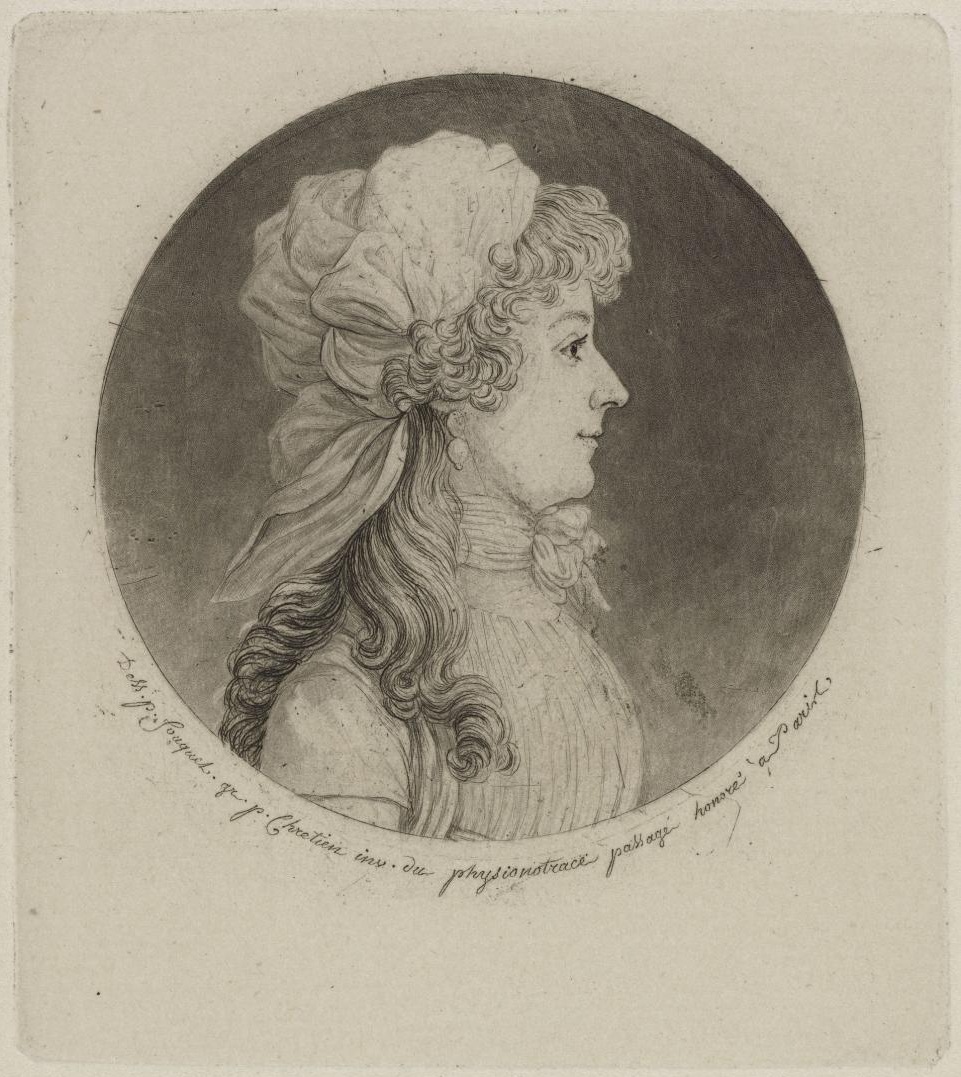
In April 1785, Voyages was registered with the guild and subsequently issued with a permission tacite (tacit permission), allowing it to be published and distributed. As part of the registration process, the book’s translator was named. Here, the register took me by surprise: not only was the translation not Brissot’s, it was not Félicité’s either. The real translator was, in fact, Félicité’s teenage sister, Marie-Anne, known in the family as Nancy.
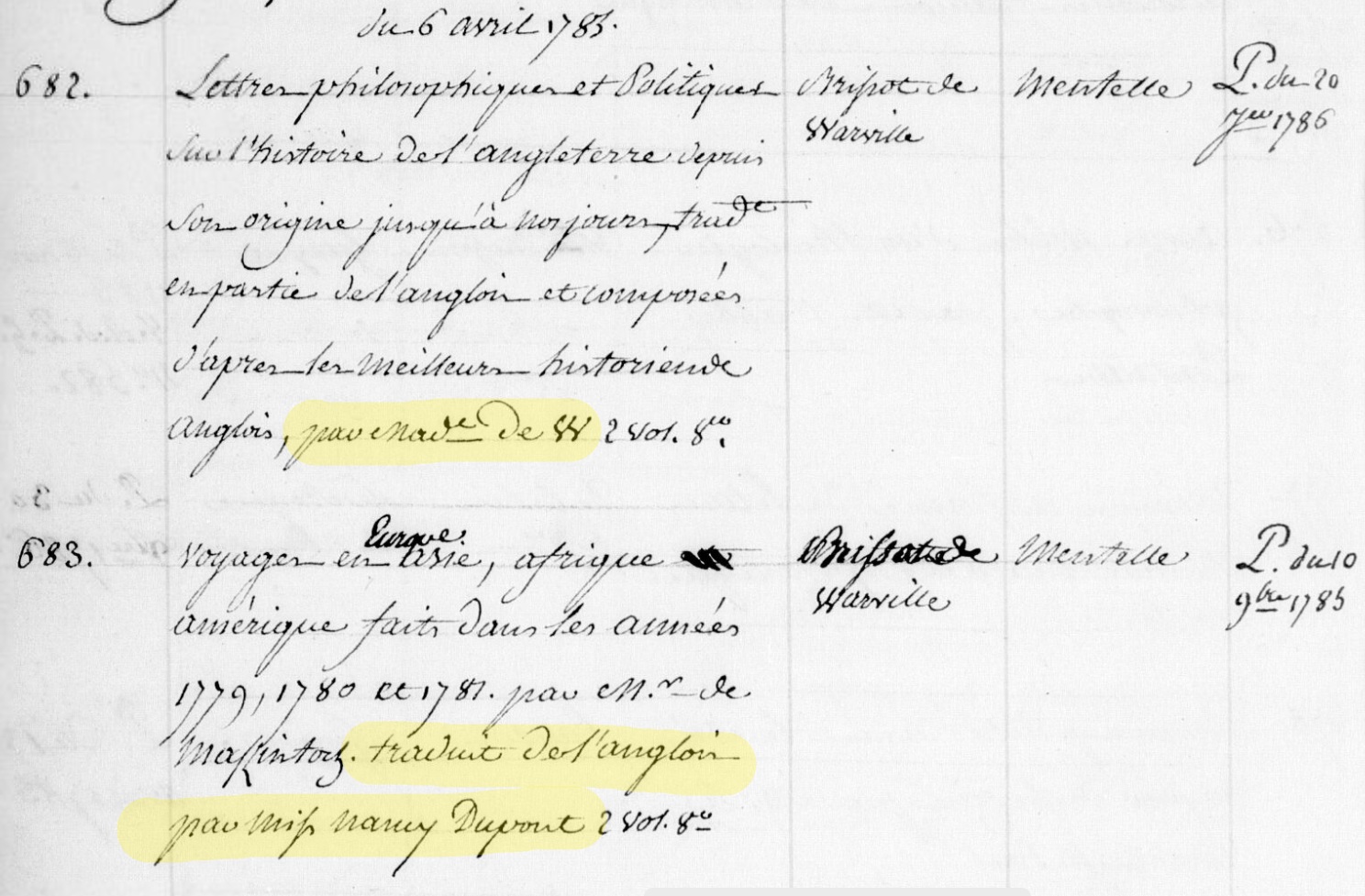
At the time the translation was undertaken (somewhere between the autumn of 1783 and the spring of 1784), Nancy was living in London with her sister and brother-in-law, who had relocated there from France in order to pursue Brissot’s dream of establishing a new literary and philosophical society, the Lycée de Londres. At this time, Brissot was busily engaged in various publishing ventures, including the six-part periodical Tableau de la situation actuelle des Anglois dans les Indes Orientales. Brissot had encountered Macintosh’s book as part of the wider research that supported the composition of the Tableau, and decided at some point in 1783 that a full-scale French translation was required as a supplement of sorts to the Tableau. Félicité, who might ordinarily have performed the literary labour of translation was occupied with a different task: translating and adapting Oliver Goldsmith’s An History of England, in a Series of Letters from a Nobleman to his Son (1764), subsequently published in Paris in 1786 as Lettres philosophiques et politiques sur l’histoire de l’Angleterre. The task of translating Travels was, therefore, taken on by Nancy, in the year she turned sixteen.
Travels was a long book (around 150,000 words) and full of references to places and people with whom Nancy was probably unfamiliar. This was not, then, an insignificant undertaking, but it would have been done with the support of Félicité and in close consultation with Brissot, who took on a more editorial role in the production of Voyages—supplementing the book with a preface and footnote commentary, as well as emending the text in some places, expanding it in others, and clarifying it elsewhere. Even with support, Nancy’s task was substantial and challenging, but she clearly possessed the skill and capacity to do it. Brissot would later tell his Swiss publishers, the Société typographique de Neuchâtel, that he was très content with they way the translation had turned out.
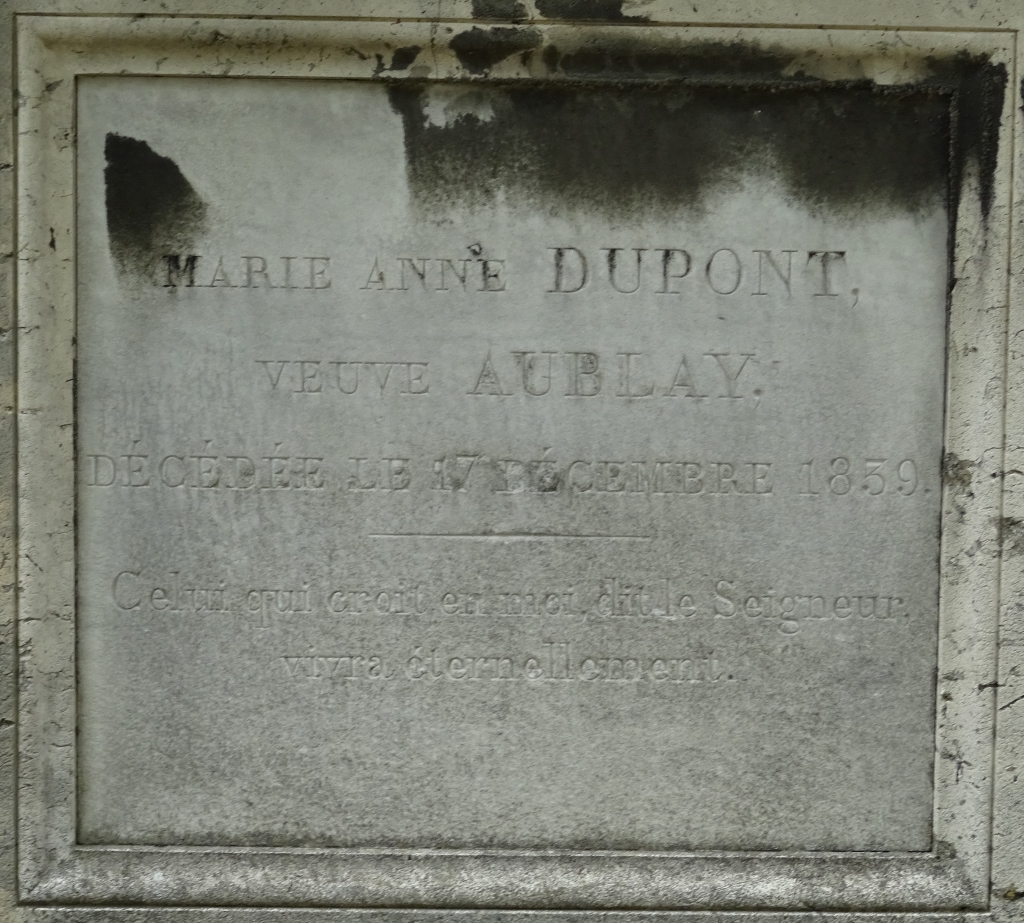
Nancy’s subsequent life was eventful, but obscure in the historiography. She went on to marry Edme-Pierre Aublay, lived for a time in Philadelphia, ran a small boarding school (first on Cherry Street in Birmingham and then on Russel Square in London), endured the tragic death of her son, Francis (or François), an undergraduate student at the University of Oxford, corresponded with Joseph Banks, dedicated a book of religious instruction to her grand nephews, Felix and Eugene, invoking their learned grandfather, Jacques-Pierre, found herself one day captivated by the religious writing of Sir Matthew Hale, and died on the rue Saint-Honoré in Paris in December 1839, aged seventy-three. She was buried in the Père Lachaise cemetery.
Nancy’s labour on Voyages would have remained entirely invisible were it not for one line in the registers of the Paris book guild. I’m just glad I found it!