
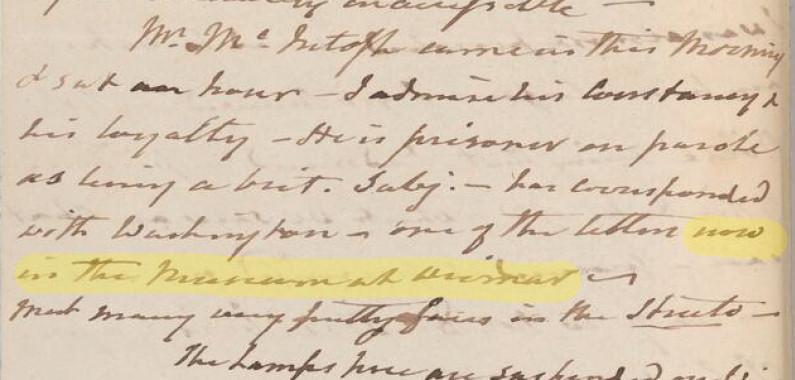
Long-time readers of this blog will know that I have been trying for some time to understand the journey of one of Macintosh’s letters from George Washington, originally received by him in Avignon in 1788. When, twenty-two years later, Aaron Burr met Macintosh in Eisenach, Burr recorded in his journal that the letter from Washington was “now in the museum at Weimar.”
In late 2024, with the kind assistance of Dominik Hünniger, I traced the letter to the Goethe- und Schiller-Archiv in Weimar. Subsequent investigation revealed that the letter had previously been part of Goethe’s large collection of autographs and, more recently, had been on display a number of times at the Goethe- und Schiller-Archiv as one of its archival treasures.
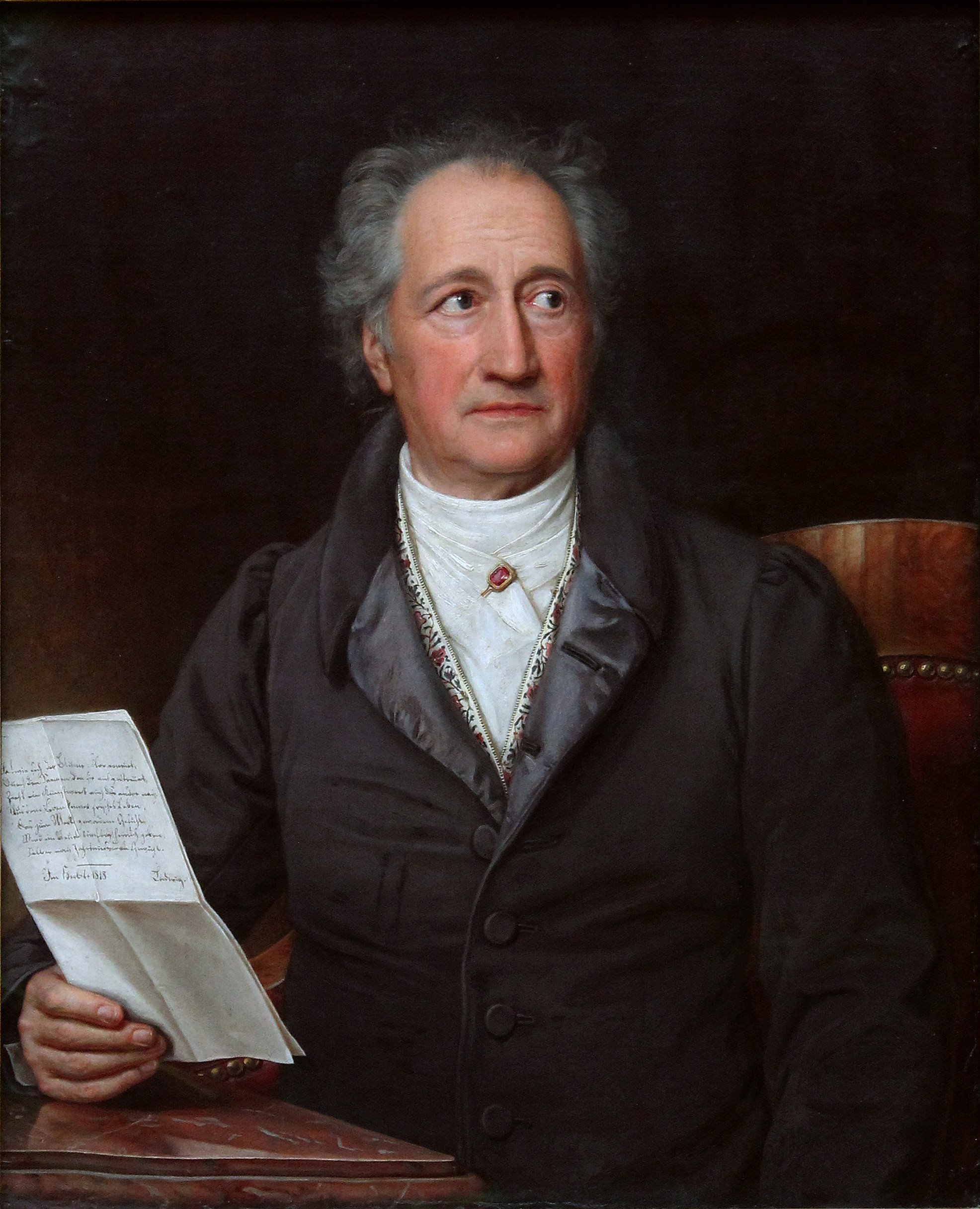
Two questions remained: 1) How did the letter come into Goethe’s possession? and 2) In which museum had it been displayed when Macintosh and Burr discussed it in 1810?
The answer to the first question comes (at least in part) from a letter to Goethe from his secretary-librarian Friedrich Theodor David Kräuter. Dated 28 August 1818, Goethe’s sixty-ninth birthday, Kräuter’s letter enclosed a much-wished-for addition to Goethe’s autograph collection: “the authentic signature of the great liberator of the New World [die beygelegte ächte Unterschrift des großen Befreyers der neuen Welt].” Although Kräuter does not mention Washington by name, it is highly likely that this is who he was referring to. Kräuter goes on to explain that he stumbled upon the letter containing Washington’s signature simply by chance.
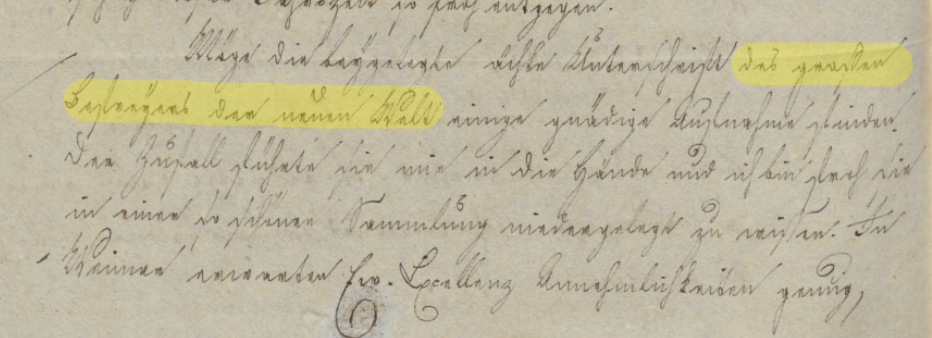
Detail of Kräuter’s letter to Goethe. Goethe- und Schiller-Archiv, 28/79, Bl 533-534.
In attempting to answer the second unresolved question, I received some very helpful advice from Sabine Schäfer at the Goethe- und Schiller-Archiv. She was able to point me towards a source—Goethes “Bildergalerie”: Die Anfänge der Kunstsammlungen zu Weimar (2002)—that details a short-lived museum that was established in 1809 in the Fürstenhaus on Fürstenplatz (now Platz der Demokratie) where the family of Karl August, Duke of Saxe-Weimar-Eisenach lived. The four-room museum displayed a variety of artworks and, so it would seem, Macintosh’s letter from Washington.
The museum closed in January 1811 and the paintings (and the letter) were moved to the ducal library. The following year, one of Goethe’s friends and colleagues, Christian Gottlob von Voigt, who, with Goethe, was responsible for overseeing the library, wrote to him to explain that he had long intended to give the Washington letter to Goethe, but had been unable to find it among the chaos of his papers. Months later, Voigt was still unable to locate it.
So, now we know (or can be reasonably confident) that Macintosh’s letter from Washington was on display in the museum in the Fürstenhaus in 1810, that it was subsequently transferred to the ducal library, thereafter was lost or mislaid, then found its way to Kräuter, before becoming a memorable gift for Goethe’s sixty-nineth birthday.
As is often the case with this project, answering one question inevitably raises others. How did the letter come to be in the museum in the first place? Did Macintosh donate it to von Voigt directly? Did he hope that the letter might secure him some social capital? As ever, there is more digging to do!