Looking ahead to 2016; or, here’s to another year of slow scholarship

Highland Archive Centre. © LDN Architects.

Highland Archive Centre. © LDN Architects.

The arrival of a new baby just before the start of a busier-than-ever teaching term has meant very little time for work on Macintosh (aside from putting together a small grant application which, I hope, will allow me to consult Macintosh’s book collection in Avignon). I have, however, managed to identify a number of potential leads for further archival work in 2016.

The most interesting of these lines of enquiry (famous last words) is a collection of material previously housed in the Highland Council Archive, but now in the Highland Archive Centre in Inverness—”D351: Mackintosh of Balnespick, 1606–1895“. The Scottish Archive Network has a record for William Macintosh and connects it to this collection. Whilst I suspect there is a degree of conflation/speculation in this connection, the collection is, nonetheless, worth investigating, not least for an 1895 document contained therein: Historical notes on the Mackintoshes of Gask and Balnespick by Charles Innes. If only to obtain further contextual information about Macintosh’s family, a visit to Inverness to consult this material has found its way onto my 2016 to-do list.

The Fraser Mackintosh Collection at the Inverness Library.

The Fraser Mackintosh Collection at the Inverness Library.

A rather more speculative lead (also in Inverness) comes through the excellent-looking “Meet the Books” project at the Inverness Library. Led by Dr Kristin Lindfield-Ott (University of the Highlands and Islands), the project is examining the 5,000-volume collection of Charles Fraser-Mackintosh (1828–1901). The collection is partly accessible thanks to the digitisation of the original card catalogue (above) by the Highland Libraries Special Collections.  I have reason to believe that one of the books in the collection—Lewis Chambaud’s The rudiments of the French tongue (1802)—may have belonged to William Macintosh; it is described in the catalogue as being “Inscribed by Willaim [sic] Macintosh”. Dr Lindfield-Ott has kindly agreed to examine the book’s ownership inscription on my behalf. Fingers crossed.

2016 should see the publication of a book chapter—”Circulating seditious knowledge: the ‘daring absurdities, studied misrepresentations, and abominable falsehoods’ of William Macintosh”—in an edited collection in Springer’s “Knowledge and Space” series. The chapter was written early in 2012, so it will be nice finally to have it out. I am also due to give a couple of papers on the Macintosh project in Glasgow and Cambridge, but the main business of 2016 will be to complete a large grant application to support the archival work in Britain, France, Germany, and the United States on which the larger book project will eventually depend.

Here’s to another year of slow scholarship!

Macintosh’s vision for the United States

Macintosh's "Plan of Government suggested for the United States of America" (20 August 1787). George Washington Papers at the Library of Congress, 1741-1799: Series 4. General Correspondence. 1697–1799.

Macintosh’s “Plan of Government suggested for the United States of America” (20 August 1787). George Washington Papers at the Library of Congress, 1741–1799: Series 4. General Correspondence. 1697–1799.

In August 1787, less than a month before the Constitutional Convention concluded its work drafting the United States Constitution, George Washington was sent an unsolicited, but passionately argued, letter from William Macintosh setting out a “Plan of Government…for the United States of America”.

Macintosh’s scheme, one of many Washington received that year, is uncommon in its detail and is also revealing of Macintosh’s political philosophy. In his view, the United States was an exceptional case and no existing model of government would suit its future requirements. As he informed Washington,

none of the forms heretofore known in civilized nations, appear adapted to answer the salutary ends of the people of America, the great point is, how to constitute a Government, which will embrace such a mixture in its composition, as to Legislate, administer, and Execute, without democracy, Aristocracy, or Monarchy.

Macintosh sought to do just that in setting out a scheme for a form of commonwealth, with a government “composed of a Supreme, or Executive-Chief,—Senators,—and Commoners“. There is much to be made of Macintosh’s proposal (and his motivations for developing it). For now, though, it is sufficient to note that his plans reached Washington too late—arriving just after the drafting of the Constitution had been completed.

Washington’s courteous and encouraging reply to Macintosh (sent in January 1788) enclosed with it a copy of the new Constitution. Macintosh later flattered himself by noting that his vision for the United States and its agreed-upon Constitution displayed “so striking a resemblance in their Outlines & features”.

As far as I have been able to determine, Macintosh’s scheme has only once been the subject of scholarly attention (and scathing attention at that). The legal historian Leon Fraser (1897–1945) addressed the plan briefly in his 1915 doctoral disseration, English opinion of the American Constitution and government (1783–1798). There, Fraser dismissed Macintosh as “Our English [Emanuel] Sieyès” and his scheme as nothing more than a “hot-house constitution”.

Ancestor hunting

Achinduich Lodge. © Donald Bain and licensed for reuse under a Creative Commons Licence.

Achinduich Lodge. © Donald Bain and licensed for reuse under a Creative Commons Licence.

This week I received a wonderfully detailed email from William Macintosh’s descendant, Deirdre Grieve, who—with her sons—has recently completed an “ancestor hunting” trip around the Highlands in search of locations associated with the Macintosh family.

One of Deirdre’s first ports of call was the old parish church at Alness, where it is presumed certain members of the Macintosh family were buried. The building is, however, in a parlous state and fenced off. Moreover, various grave markers (that were removed by the local council for safekeeping) seem to have been lost or misplaced—a fact confirmed to Dierdre by the Alness Heritage Centre. It is not, therefore, possible to visually confirm any Macintosh family burials on that site.

More positively, Deirdre reckons that there is reason to suspect that Achinduich—a small settlement on the Skibo Estate—was at one time home to Macintosh’s parents. The present building at the site, Achinduich Lodge (above), was built for Andrew Carnegie in the early twentieth century and is now available to rent as a holiday let.

Deirdre went on to meet with the local historian Reay Clarke (author, most recently, of the 2014 book Two hundred years of farming in Sutherland: the story of my family). Reay is a descendant of Macintosh’s sister, Mary.

Giving it a name

The historian Matt Houlbrook has written recently about the intellectual and emotional significance of the titles we bestow on book projects. The titles authors select are not always, as Stuart Elden has reminded us, necessarily those which publishers deem suitable. Questions of marketing, audience, and discoverability inevitably come into play when deciding on the final title of a published book. Such issues notwithstanding, I took advantage of a rainy day in the office today to decide on a working title for the book which will, I hope, emerge in due course from this research project.

For a long time, I had toyed with the title Readers of revolution, since a significant portion of the book will focus on the diverse readings and influences of Macintosh’s book. Ultimately, however, I have settled for The forgotten radical: William Macintosh and the transnational circulation of seditious print in the Age of Revolution. Whilst it is unlikely that title will ever grace a book cover in precisely this form, it feels useful to have given a name to the thing that has been taking shape in my mind slowly over the last three-or-so years.

Macintosh, slave owner

Extract from Macintosh's "state of affairs". 18 December 1775. Archives départementales de Vaucluse, 2 E Titres de famille 84, “Charles Wilson / et autres de Grenade / 1767–1776".

Extract from Macintosh’s “state of affairs”. 18 December 1775. Archives départementales de Vaucluse, 2 E Titres de famille 84, “Charles Wilson / et autres de Grenade / 1767–1776″.

Last night BBC Two screened the first part of “Britain’s Forgotten Slave Owners“—a superb documentary examining the stories of slave ownership revealed by the recent Legacies of British Slave-ownership project.

Macintosh was, of course, long dead by the time the Slave Compensation Commission was established to reimburse slave holders following the 1833 Slavery Abolition Act. Given, moreover, that Macintosh left the Caribbean in a state of financial precarity (if not outright bankruptcy), there was no “legacy” of enslaved people for him to leave and thus his descendants do not feature in the Legacies of British Slave-ownership database. Many of those with whom Macintosh did business and co-owned plantations are present, however, and include James Laing and William Pulteney.

Macintosh’s papers bear witness, however, to his role as a slave owner (and certainly not a benevolent one). There is evidence to suggest that on more than one occasion he branded runaway slaves on their recapture. Whilst it will take further work to fully determine the extent of Macintosh’s holdings, there is evidence that by the end of 1775 he owned 50 enslaved people. These he described as “not attached to any plantation, being tradesmen, sailors, & domestics”. He reckoned their value at £3,000 (ten times his annual salary as Comptroller of His Majesty’s Customs).

Macintosh’s status as a slave owner was not unusual in this period, but it does sit somewhat uneasily alongside his later promotion of egalitarianism and individual rights in the context of British India. Whether he experienced a Damascene conversion, or for reasons of pragmatism simply believed a different means of colonial management were required there, is not yet clear. Further digging is, as ever, required.

Macintosh at the ICHG

On the stage at the ICHG. Photograph courtesy of Julian Baker.

On the stage at the ICHG. Photograph courtesy of Julian Baker.

Last week I was fortunate to participate—along with c. 700 others—in the 16th International Conference of Historical Geographers. It was a wonderful event and a model of organisation, scholarship, and collegiality. On the last day of the conference (somewhat jaded by a week of early mornings and late nights) I presented in a session convened by David Lambert and Peter Merriman: “Mobility and empire“.

My paper, “William Macintosh’s Travels: colonial mobility and the circulation of knowledge”, was a version of a book chapter written in early 2012 which has, since then, been inching its way through the production process and should emerge in 2016 in a forthcoming volume of the Springer “Knowledge and Space” series. Having sat dormant for so long, it was good to dust the paper off and introduce some of my Macintosh work to colleagues. A number of useful questions, not least concerning Macintosh’s apparent transition from slave owner to advocate of individual rights, have given me much to think about.

In addition to the other excellent papers in the session, particular highlights during the conference were provided by the three plenary speakers: Catherine Hall, Bill Cronon, and Simon Schaffer.

The Irish connection

Advertisement for "Travels". The Belfast Mercury (15 June 1790)

Advertisement for “Travels”. The Belfast Mercury (15 June 1790).

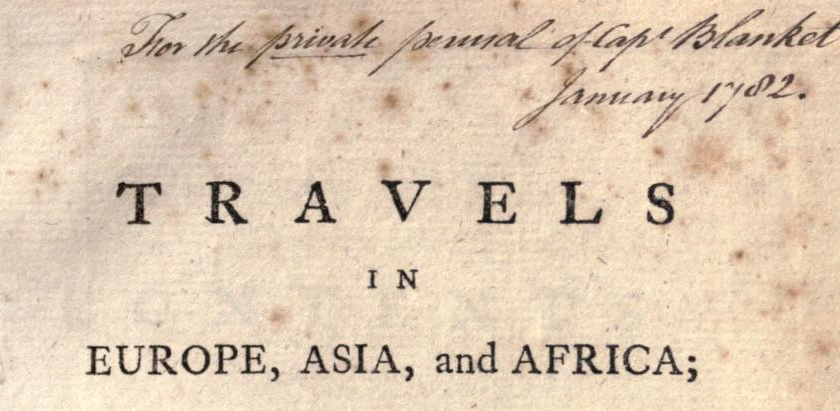
In an earlier post I discussed one of Macintosh’s American readers, Charles Pinckney, and his copy of Travels (housed in the Irvin Department of Rare Books and Special Collections at the University of South Carolina). Pinckney’s copy (of the 1782 Dublin edition) has an advertisement pasted onto the front flyleaf, highlighting the book’s contemporary significance in the lead-up to the impeachment and trial of Warren Hastings.

The text of this advertisement was, however, reused and recycled for at least 8 years—a fact attested to by its reappearance (above) in a June 1790 issue of The Belfast Mercury. The advertisement was issued in this case by the Belfast bookseller James Magee (in cooperation with the Downpatrick bookseller Margaret Hart) at the point of a dissolution in Warren Hastings’ long-running trial.

I cannot imagine that there were very many female booksellers in eighteenth-century Ireland, but the secondary literature is rather silent on Margaret Hart. In his 1987 book The printed word and the common man: popular culture in Ulster, 1700–1900, Adams only notes matter-of-factly that “Around 1782 James Magee’s advertisements frequently mention the name of Margaret Hart, bookseller, Downpatrick, for no apparent reason” (p. 28). It is evident, however, that Hart was not just a bookseller; she also—as is indicated by Dudley in her book The Irish Lottery, 1780–1801 (2005)—sold lottery tickets from an office in Downpatrick. Hart will, of course, have to remain another scholar’s quarry.

Macintosh’s library

La Médiathèque Ceccano, Avignon. Home to Macintosh's library.

La Médiathèque Ceccano, Avignon. Home to Macintosh’s library.

When I visited Avignon in September 2012 to begin a pilot phase of archival research on William Macintosh at the Archives Municipales, I walked past one of the city’s libraries every day without realising that it was home to Macintosh’s personal book collection. Opened in the early 1980s, the Médiathèque Ceccano houses the city’s collection of rare and historical books which were previously held at the Muséum Calvet. The origins of Avignon’s library collections begin with the French Revolution and the seizure during that period of the contents of religious libraries and those collections belonging to immigrants to the city. Among the victims of the so-called “confiscations révolutionnaires” was William Macintosh and his library of 70 titles. His home and his books were sequestered in September 1793 apparently in retaliation for the fall of Toulon.

The existence of Macintosh’s library is recorded in Georges Dickson’s 1993 book Jacques III Stuart: un Roi sans couronne. Dickson’s book contains a facsimile of the first page of the catalogue of Macintosh’s collection (listing the first few titles in his library). Due to the poor quality of the facsimile it is a little difficult to decipher the titles of the books (not least since they are descriptions in French rather than precise transcriptions of titles). Nevertheless, it is possible to begin to draw up an inventory of Macintosh’s collection:

  1. Unidentified
  2. Unidentified
  3. Treatise and grants from the country powers, to the East-India Company, respecting their presidency of Fort St. George, on the coast of Choromandel; Fort-William, in Bengal; and Bombay, on the coast of Malabar. From the year 1756 to 1772. (1774) Shelf-mark: 4 ° 2563.
  4. The history of America, by William Robertson (1777) 2 vols. Shelf-mark: 4 ° 2460.
  5. A course of experimental agriculture; containing an exact register of all the business transacted during five years on near three hundred acres of various soils; including a variety of experiments on the cultivation of all sorts of grain and pulse, both in the old and new methods, by Arthur Young (1770-71). 2 vols. Shelf-mark: 4 ° 1326.
  6. Dizionario delle lingue italiana, ed inglese, by Giuseppe Baretti (1787). 2 vols. Shelf-mark: 4 ° 1742.
  7. Unidentified
  8. The history of Hindostan; from the earliest account of time, to the death of Akbar, by Alexander Dow (1768). 2 vols. Shelf-mark: 4 ° 2560.

In some respects, this brief list is a microcosm of Macintosh’s interests (although the Italian-English dictionary is a little unexpected). Dickson’s book also contains a facsimile of the title page of the dictionary, which shows that Macintosh bought the book in Rome (although the date of purchase is illegible in the facsimile). There is clearly the potential to glean much insight into Macintosh from his reading habits (not least if he was in the habit of annotating his books). I hope in the short term to be able to locate the full catalogue of his books and, if future funding allows, to visit the Médiathèque Ceccano to examine the titles in person.

Macintosh in Caribbeana

Title page of Caribbeana, volume 1.

Title page of Caribbeana, volume 1.

In 1909 a new quarterly periodical focussing on Caribbean genealogy was launched by the wonderfully named genealogist Vere Langford Oliver (1861–1942). Oliver’s journal—Caribbeana—ceased publication only ten years later in 1919 after six volumes and three supplements. Caribbeana has been digitised as part of the Digital Library of the Caribbean and is an important work of reference for scholars working on the history of the Caribbean. Macintosh makes a few, small appearances in the pages of Caribbeana.

Under the heading “A List of West Indian Deeds on the Close Rolls”, volume 1 of the journal records the following, for example: “George Johnston, John Rae by William Macintosh, Ann his wife. Grenada [1764], 14-12-13”. Read out of context, and in this abstract form, the information is not obviously revelatory. This snippet is interesting, however, because it dates Macintosh’s acquisition of land in Grenada and records the name of his wife (the first source I have seen which does so).

It is not immediately clear where these deeds are now stored. I assume they were Public Record Office documents originally, but it will take a bit of detective work to determine how they are now classified and where they are located.

Mary Macintosh

In response to an earlier post on the hard-to-verify date and location of William Macintosh’s birth, I received a helpful email recently from Deirdre Grieve, a descendant of Macintosh whom I had the pleasure of meeting last year. Based upon her own genealogical research (and her mother’s 1970s correspondence with another Macintosh descendant), Deirdre has pointed me in the direction of William’s sister, Mary Macintosh (d. 1827). Mary is recorded as having married Alexander Falconer (1730–1802), a minister at Eddrachillis in Sutherland, in 1764. Together they had 12 children—William’s nephews and nieces. In order of birth they were Helen, Fairly, Barbara, Joanna, Mary, Anne, John, James, Alexander, James, George, and Lachlan.