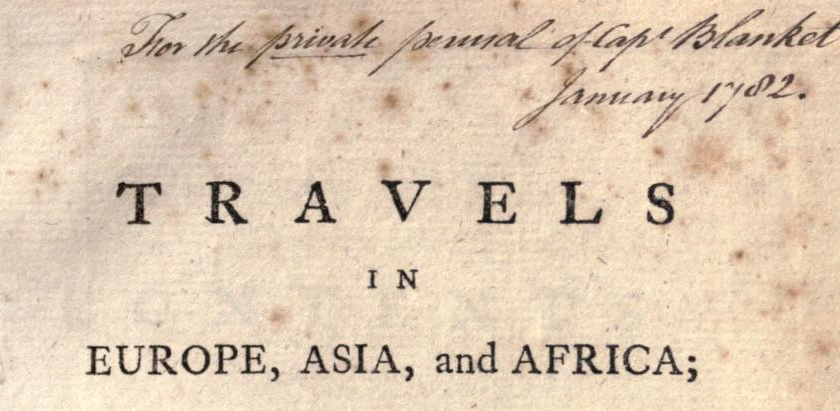
On 17 September 1776, the British diplomat Sir Joseph Yorke wrote to Lord Suffolk to convey his suspicions about an individual who seemed to be collecting information in the Netherlands relevant to the rebellious Americans:
I have learnt that Macintosh is certainly in correspondence with America! His original business in Holland was to study the minute parts of the constitution of the Republic, and to transmit the model to the trans-Atlantic legislators. I make no doubt he has ingrafted other information upon that original commission, and does as much mischief as ever he can: still, however, Your Excellency may look upon Dumas, as, properly speaking, the Congress agent.
York to Lord Suffolk, 17/09/1776
A year later, on 31 December 1777, James Moylan—a pro-Revolution commercial agent in France—wrote from L’Orient to the diplomat Arthur Lee on the subject of a suspicious character:
Mackintosh has not been here Since my arrival, but I learn there were grounds for our Suspicions of him
Moylan to Lee, 31/12/1777
Could Macintosh and Mackintosh be the same individual? If so, could this be my Macintosh? Suspected by the British as a spy for the Americans, yet suspected by the Americans in turn? Right now, I have no idea; all I have is circumstantial evidence:
Macintosh was often in the Hague and Amsterdam in 1776;
Correspondence places him in L’Orient at the time Moylan was writing (indeed on the very same day);
He took an active interest in the American Revolutionary War and advocated a compromise, but fundamentally sided with the British.
Did Macintosh’s irrepressible political curiosity lead both parties simply to mistake his intentions? Are there sufficient grounds here for speculation?
“List of Articles which I would recommend to Mr. MacIntosh to bring out with him by the Way of Suez.” Does this hint at the original purpose of Macintosh’s visit to India? A plan to send from France boxes of coral, silk, and gauze? Archives départementales de Vaucluse, 2 E Titres de famille 83, “Pieces de comptabilite”.
I am—after 115 days of writing and c. 99,000 words (including notes and references)—at the very end of Macintosh’s time in the Caribbean. It was, for him, such an eventful, complicated, and consequential period in his life that I never thought I’d be able to encompass it. There are, of course, a thousand stories in the archive that still remain to be told about that period, but since I don’t have the luxury of two or more volumes for this book, I will have to leave those for others to uncover. There are, equally, stories I’ve now written that will need to be cut or entirely discarded when I return to the job of editing and pruning this section of the book. It is, by any standards, too long, particularly with three big empirical chapters still to come (not to mention the introduction and the conclusion).
Moving, as I will do shortly, to the next part of the book—which concerns Macintosh’s journey to India—feels like starting an entirely new work. The context is different, the literature is different, the places and people are different. It took me much of the last year to really feel like I’d got to grips with the Caribbean (at least enough to contextualise Macintosh’s experiences) and now I’m starting that process again from scratch. It’s exciting, but also intimidating. I know, too, that I’ll have to do it all again for the final part of the book that deals with Macintosh’s time in France and his experiences of the Revolution. Again, thrilling and anxiety-inducing in equal measure.
This month’s blog post comes a little earlier than usual as the school half-term holiday (aka pandemic circuit breaker) starts tomorrow and I will consequently be downing tools until 1 November. I’ll then have six or seven weeks to push the India chapter forward, the first fortnight of which will likely be devoted to background reading and research. I’m particularly looking forward to puzzling out the sequence of events that led Macintosh to India. I suspect, but am not sure, that it was the result of a plan hatched with his long-time friend Lauchlin Macleane, but one ultimately scuppered by Macleane’s death. At this stage, who knows? I look forward to finding out.
I am now fairly close to having finished writing three very long chapters covering Macintosh’s quarter-century in the Caribbean. This was an eventful and tumultuous time in his life (as well as in the politics of empire) and it has been a wonderful, although occasionally overwhelming, challenge to reconstruct that period from its archival remains. Not for the first time, have I silently (and sometimes not so silently) cursed the fact that no one has done this before me and ache for the reassurance that an earlier biography of Macintosh would provide. As often as I fear I might never understand some event in his life, however, I am surprised that the answer is there, somewhere, among the thousands of archival photographs sitting on my computer.
I have, I suspect, about two more weeks’ work to bring this part of the book to a close and to follow Macintosh from the Caribbean to India. I will be sad, in many ways, to leave the Caribbean behind, just at the point I feel like I am beginning to understand it (and its enormous secondary literature), but I am looking forward to the new challenge of coming to terms with the complex politics of British India in the 1770s and ’80s. The three Caribbean chapters will, I think, each need to be split in two to prevent them from being too unwieldy, but that is a job for another day in another year.
One thing the Caribbean section of the book has done is to make me reflect about the moral questions raised by the act of recovering Macintosh’s life from historical obscurity. What, one might ask, is the moral justification for writing 165,000 words on the life of an individual who owned and traded slaves? Although I try, wherever I can in the book, to make enslaved people – their words and actions – visible, it is but a drop in the ocean. Such questions are thrown into even sharper relief when one thinks about how the legacy of those Macintosh worked alongside, like his co-partner William Pulteney, are now considered.
When, in 1773, Macintosh was undergoing treatment in Bath for an unshakeable bout of bilious fever under the care of the celebrity doctor Philip de la Cour, he would have seen the final stages of construction of Pulteney Bridge, a gateway and a prelude to the eastward expansion of the city in the 1780s into the Pulteney family’s 600-acre Bathwick estate. The bridge would have served then as a visual reminder of the enormous gulf in social and political standing separating Macintosh from Pulteney, whose copartnership was then on its last legs. By the end of the 1780s, Pulteney Bridge was joined by Great Pulteney Street, a long and wide avenue of Georgian townhouses, extending a quarter a a mile westwards to what is now the Holburne Museum.
2020 saw calls for Great Pulteney Street to be renamed on account of William Pulteney’s connections (partly through Macintosh) to the slave trade. One suggestion was to rename it after the abolitionist campaigner William Wilberforce, who lived at no. 36 in the early 1800s. The fact is that if Macintosh had not escaped from the historical record, we might now be having a similar public debate about how his legacy should be addressed. There is, of course, no Great Macintosh Street for us to contend with, but the possibility of one is not just theoretical; Macintosh’s brother, George—wealthier but less historically and politically significant than William—is commemorated in McIntosh Street in Glasgow.
McIntosh Street on the former site of George Macintosh’s factory and estate at Dunchattan.
What, I must ask myself, do I need to do to prevent the book becoming a printed equivalent of Great Macintosh Street? Part of this will come, I think, from the book’s criticality in attempting to think through the processes and consequences of its own making. It also comes from addressing the fact that Macintosh’s archive is also an archive of slavery and one that prompts me to address Saidiya Hartman’s question “How does one revisit the scene of subjection without replicating the grammar of violence?”
In many ways writing a book with a biographical focus should be easy: you simply follow an individual from birth to death and write about what comes in between; the structure being dictated by the inevitable forward progression of time. In reality, of course, it is much more difficult than that—it is necessary to identify the narrative threads and conceptual arguments that run across the book and the life, to identify the events that best exemplify those arguments and provide those threads, and to think about each chapter as a step in developing the book’s wider intellectual contribution. The task is complicated further when, as in the case of Macintosh, you don’t know for sure—until you begin the iterative process of researching and writing—where following a life will take you next. For all of those reasons, I never quite felt ready to write a book proposal. While it is normal (and perhaps best) practice to write the proposal before writing the book, or very much of the book, I was reluctant to do so when so much was still unknown and felt uncertain as a result. Nevertheless, as a result of the gentle and encouraging prompting of my prospective editor and of a colleague during my annual review, I finally bit the bullet and put together the proposal.
The proposal for a book whose title will almost certainly change.
The act of writing a proposal is the act of making (and defending) decisions about content, structure, and focus. Persuading others about a book’s purpose, contribution, and value is, in many respects, a helpful way of boosting one’s own confidence about a book and it has certainly given me a greater sense of the role I would like to see this one play. At the same time, making solid plans about the organisation of a book—in terms of structure and production timeline—is also a useful disciplining mechanism; it imposes a deadline and a clear set of parameters within which to keep the book focussed. I won’t pretend it was an easy proposal to write (it wasn’t), but I am glad to have done it. I am even more pleased that the proposal was positively received by McGill-Queen’s University Press, who are kindly in the process of drawing up an advance contract.
The proposal locks in (more or less) an eight-chapter structure: six empirical chapters plus the (still fairly empirical) introduction and conclusion. At the moment, I have written two and a half of those (rather long) empirical chapters and will aim to write one and a half more during the remainder of my fellowship. Mindful that my writing will inevitably slow when I return to normal duties in January, I have proposed a September 2023 deadline (with two empirical chapters to be written in 2022 and the introduction and conclusion in 2023). This is, I remind myself several times a day, a marathon and not a sprint.
Although I am still deeply immersed in the Caribbean phase of Macintosh’s life, and will be so until I finish the chapter I am currently working on, I cannot resist the temptation to skip forward to glance at some of the material I will be dealing with later in the project, particularly that relating to the French Revolution and to Macintosh’s counter-revolutionary activities.
Macintosh’s writing on the Italian campaigns of the French Revolutionary Wars, for example, makes great play of his earlier on-the-ground experience in Italy and his knowledge of Italian politics. His opinions were, he told one correspondent in May 1796, “founded in a local knowledge, & studied observations on the principles of the people, in general, in the different States of Italy”. In 1790, when in Rome, Macintosh had shared his political analysis with Francesco Saverio de Zelada, the Pope’s Cardinal Secretary of State. On that occasion, Macintosh had warned de Zelada that Leopold II and Ferdinand IV were planning to “seize and annex the church territories in Italy”. “If the Court of Rome did not speedily change the mode, & soften the rigors of Government,” he told de Zelda, “the combustible matters were ready prepared to receive the matches, and that the public mind throughout his Holinesses [sic] dominions, was disposed to receive the Law from other Sovereigns, more tender & just towards the property & industry of their Subjects”.
Portrait of Cardinal Zelada (1773) by Anton Raphael Mengs (1728–1779). Art Institute of Chicago. 1969.2.
By 1796, Macintosh’s assessment was that the annexation plan had been “hushed by the urgency of stemming the revolution in france [sic]”, and by Leopold II’s death in 1792; he nevertheless retained a deep suspicion of the government in Vienna, believing that it was advancing “an obstinate, systematic plan of secret-ambition”. In this respect, Macintosh subscribed to what was then emerging as a commonplace conspiracy theory: that the continent’s governments were “under the direction, & profound Machinations of a Select-Committee of Illumine’s [sic]”. Macintosh had written to London on this subject—the influence of the Illuminati—in 1794, but I have not yet located that report. As ever, there is a lot more digging still to do!
Detail of the 1818 Cadastre napoléonien showing the location of Mas des Cannes, Macintosh’s country house, in the Montfavet district of Avignon. Archives départementales de Vaucluse, 3 P 2-007/36.
Although working out exactly where Macintosh lived in the countryside outside of Avignon in the 1780s is not, in any fundamental sense, vital to my research, it is a puzzle that I have found difficult to resist. Much of the impetus behind my desire to know where he was living comes from the fact that so much of his correspondence during this period was concerned with the house and with a long-running dispute with his landlords (the Messieurs Monery, father and son) over its quality and state of repair.
“Plan of the augmentations agreed between me & Mr. Monery—exhibited the 1st June 1784”. Archives départementales de Vaucluse,2 E Titres de famille 86, “Maison de Chateaubrun / 1784–1788”.
Thanks to Macintosh’s plans of the building, such as the one above, I have a fairly good sense of what it looked like, but where, precisely, it was has always been something of a mystery. Macintosh’s letters from the period are generally addressed to and from “Chateau Brun”, which I had taken to be the name of the building, but in one document it is referred to as “Mas des Cannes”. A clue in a twentieth-century cadastral register indicates, however, that Chateau Brun was a neighbourhood or place name—a quartier or lieux—in the district of Montfavet and that the farmhouse itself was called Mas des Cannes.
Although it appears that the farmhouse was razed during the twentieth century, I am fairly confident that it is represented as no. 110 on the 1819 plan, which would place it at what is now the intersection of Rue des Peupliers and Chemin du Cèdre in Montfavet, a little less than six kilometres as the crow files from Macintosh’s townhouse in Avignon. It is another piece of the puzzle, and by such pieces the picture takes shape.
3D view of the former location of Mas des Cannes, at the intersection of Rue des Peupliers and Chemin du Cèdre.
79 days of writing visualised; or, the beginnings of a very long first draft.
Although I find it difficult to believe, I have now completed 10 months of my Leverhulme Research Fellowship. For all that those 10 months have been disrupted by home schooling, archive and library closures, and the general restrictions of lockdown, they have, nevertheless, been totally transformative for my work on Macintosh. Being able, as I have, to devote all or part of 202 working days to the task—including 79 spent writing—has been the greatest privilege. I now have about 66,000 words of the book (including notes) and a greater sense of confidence that it will be possible, one day, actually to complete it.
During June I was able to begin work on the book’s third empirical chapter (of six or seven; we’ll see how it goes), which deals with Macintosh’s final years in the Caribbean and his unexpected transition from planter to world traveller. This was a period of rapid ascendancy for Macintosh, which began in 1770 with the negotiation of a loan from the Dutch bank Hope & Co. and the purchase of plantations in Tobago and Dominica, but also of precipitous decline, largely as a consequence of the aftereffects of the 1772 financial crisis, which had been precipitated by Macintosh’s friend and trustee of his Dutch mortgage, Alexander Fordyce. This is also the period during which Macintosh met Olaudah Equiano and during which he reflected about the differential status of free and enslaved black bodies. It was also the period of his final efforts to challenge the political status quo in Grenada and to unseat Robert Melvill from his role as Governor. I have found Macintosh’s time in the Caribbean endlessly fascinating, and I will be sad to leave it behind when I finish this chapter, but, equally, I am keen to move the narrative along and to follow Macintosh to India.
This month, Jaz Bigden (aka Team Macintosh 4.0) completed his master’s placement with me, having compiled two very useful indices of Macintosh’s letterbooks. Since the first of these letterbooks is not in strict chronological order, having an index is extremely useful in following the threads and sequence of correspondence. If Macintosh’s letters are ever digitised, these indices will also prove extremely helpful as an organisational framework. Elsewhere in the Macintosh Expanded Universe, my dad (aka Team Macintosh 3.0) has kindly continued his beyond-the-call-of-duty transcription efforts, in attending to material from the British Library relating to Macintosh’s counterrevolutionary activities in the 1790s.
June also saw the publication—in The Library: The Transactions of the Bibliographical Society—of my catalogue of Macintosh’s private library. This was, in lots of ways, a labour of love and I’m delighted to see it out in the world.
A cypher for places, people, and events, sent from Bern in December 1796. British Library, Add MS 22903, f. 11r.
Although (or perhaps because) I am still deeply immersed in writing about Macintosh’s experiences in the Caribbean during the 1770s, I cannot resist looking forward to the material that lies ahead. My recent visits to the British Library have allowed me to begin filling in the fascinating details of Macintosh’s counterrevolutionary activities in Switzerland and the levels of secrecy that were required in order to communicate transnationally during the French Revolution.
Alongside the use of sympathetic ink, Macintosh recommended in a memorandum to Charles Jenkinson, then President of the Board of Trade, that a common cypher (above) be used to facilitate safe communication and “to secure agents against surprise”. This period in Macintosh’s life—mysterious by design—is one that I am very much looking forward to tackling and untangling.
For a number of years I have been in discussion with a kind and encouraging editor at a university press over my planned book. His patience has been exceeded only by my slowness in formalising my ideas in a book proposal. In this respect, I have been approaching things in a rather back-to-front way; my previous practice—such as it is—has always been to tackle the proposal first before starting to write the book itself (or, at least, before having written very much of it). My slowness—or, more properly, my reluctance in this case—stems from three concerns: first, my uncertainty over the likely length of the final book and its number of chapters; second, the difficulty I have in estimating how long the book will actually take me to finish; and third, my seeming inability to identify a title for the book that I am happy with.
While I have a well-developed sense of the book’s overall structure in terms of chronology, key episodes, and themes, the fact that I am researching as I write, means that, quite naturally, I find the book’s focus shifting and its scope expanding. Where my previous books have been driven by their conceptual arguments, this book is somewhat different. It is driven, at the same time, by an act of archival recovery and an attempt to tell a particular story of empire and politics in the second half of the eighteen century through the perspective of one individual’s life. That Macintosh’s life was so varied, in terms both of historical incident and geographical experience, is what makes his story so compelling. At the same time, it is also what makes it challenging to decide how the facts of his life should be connected so as to make more than an anecdotal/empirical contribution.
While the academic “so what?” of studying Macintosh is, in some senses, easily answered in terms of what it reveals about the making and mobility of ideas of empire, about authority and influence over political decision making, about the transnational circulation of ideas, and the mechanisms and consequences of forgetting, identifying one of those as the most significant—and the one on which to hang the book’s wider conceptual contribution—is more challenging.
That Macintosh’s trajectory through life connected the geographically disparate locations of the Highlands of Scotland in the shadow of the Jacobite rising, the colonial Caribbean in the decades around the Seven Years’ War, the Early American Republic, British India, France on the eve of Revolution, counterrevolutionary Switzerland, and late-Enlightenment Thuringia makes it possible to tell a comparatively transnational story of the eighteenth century, but it does also make it difficult to know how best to pitch the book—in terms of its title—in such a way as to advertise its relevance to area/period specialists. How will scholars working in these areas know that the book has something to say to them?
Almost six years ago, I thought I had hit on the right title, The forgotten radical: William Macintosh and the transnational circulation of seditious print in the Age of Revolution, but I no longer think that does quite the right job, partly because the term “Forgotten Radical” has since then been used for a collection of Peter Maurin’s essays, partly because I have come to see that Macintosh actually vacillated between radical and conformist political stances, and partly because the focus of the book has moved to encompass more than just Macintosh’s book and its reception.
While Macintosh’s historiographical anonymity is a rationale for my project, it also presents a problem: because he has no name recognition, the book’s title must do something to indicate to the prospective reader who he was and/or why he mattered. Who Macintosh was varied, of course, considerably across his lifetime; he was variously a merchant, planter, traveller, author, political commentator, counterrevolutionary agitator, spy, prisoner, émigré, and forgotten historical actor. Which of these lives best captures his interest and relevance? Macintosh’s plurality makes it difficult to decide.
These questions could, of course, continue to swirl around my mind indefinitely, but I have committed to submitting a book proposal by the middle of September, so I will keep my fingers crossed that inspiration strikes soon.
I have been fortunate to be able take advantage of the short window of time between the relaxing of lockdown regulations and the apparent arrival of the pandemic’s third wave in the UK to return home to Scotland. In addition to undertaking archival work at the National Library and the National Records of Scotland, where I was tracking down references to Macintosh’s father in the papers of the Sutherland estate, I had the opportunity to spend an afternoon in the garden of Deirdre Grieve, William Macintosh’s great, great, great, great grandniece, whom I met first in 2014. Along with her son, Dorian, Deirdre has been an enthusiastic source of support and genealogical information since I began this project, and it was a real pleasure to bring her up to date on my work. Having spent so much time working on Macintosh in comparative isolation, being able to talk through my ideas and findings was a real confidence boost and a reminder of the fact that I am writing for a real audience (of at least two).
A marginal response in Deirdre Grieve’s copy of Travels in Europe, Asia, and Africa.
In the course of our chat, I was reminded that Deirdre’s own copy of Macintosh’s book contains a rather amusing marginal comment—”Blockhead”—which was clearly prompted by Macintosh’s discussion of the possibility that the earth might contain vast subsurface oceans, replete with “huge and stupendous” animals, à la Jules Verne.