Author Archives: Innes Keighren

About Innes Keighren

Professor of Historical Geography at Royal Holloway, University of London.

Provenance and traces of ownership

As a consequence of institutional and national digitisation projects, an increasing number of copies of Travels (in its original, reprinted, and translated forms) are available for consultation on-line. Some of these scans, as I outline below, reveal interesting indications of provenance and ownership history. As new scans become available, I will add them to this post.

[Macintosh, William.] Travels in Europe, Asia, and Africa; describing characters, customs, manners, laws, and productions of nature and art: containing various remarks on the political and commercial interests of Great Britain: and delineating, in particular, a new system for the government and improvement of British settlements in the East Indies: begun in the year 1777, and finished in 1781. 2 vols. London: John Murray, 1782.

  • Volume 2: Google Books scan of University of California copy, bearing the inscription “For the private perusal of Captn Blanket [likely John Blankett] / January 1782″.
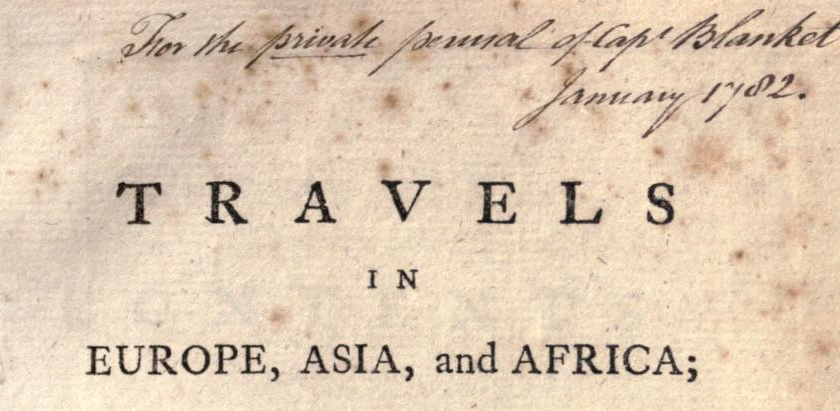
Inscription to Captain Blanket.

Inscription to Captain Blanket.

[Macintosh, William.] Travels in Europe, Asia, and Africa: describing characters, customs, manners, laws, and productions of nature and art: containing various remarks on the political and commercial interests of Great Britain; and delineating in particular, a new system for the government and improvement of British settlements in the East Indies. 2 vols. Dublin: Charles Lodge, [1785?].

  • No open-access digital version of this edition exists. Volume 1 and 2 of the National Library of Ireland’s copy has, however, been scanned under the auspices of Eighteenth Century Collections Online, Part II. This appears to bear the ownership inscription of one Anthony O’Flaherty.

[Macintosh, William.] Remarks on a tour through the different countries of Europe, Asia, and Africa; giving a particular description of the characters, customs, manners and laws of each, with their natural and mechanical productions. The political and commercial interests of the English East India Company are accurately delineated: together with a proposed and well digested system, both for the improvement and better government of their possessions in the quarter. 2 vols. Dublin: J. Jones, 1786.

  • Volume 2: Internet Archive scan of University of California copy, bound in a cover bearing the impression of “Celbridge Academy” [which occupied Kildrought House, County Kildare, from 1782 to 1814] and a plate showing the book to have been purchased under the auspices of the “Robert E. Gross Collection“.

Macintosh, William. Des Herrn Mackintosh’s Reisen durch Europa, Asia und Africa, worinnen die Charaktere, Gebräuche, Sitten und Gesetze der Bewohner dieser Länder, nebst den darinnen vorhandenen Natur- und Kunst-Producten beschrieben werden; aus dem Englischen übersetzt, und mit Anmerkungen versehen. Translated by Christian August Wichmann. 2 vols. Leipzig: Friedrich Gotthold Jacobäer, 1785.

Ex Libris from library of evangelical college.

Ex Libris from library of evangelical college.

Macintosh, William. Voyages en Europe, en Asie et en Afrique, contenant la description des mœurs, coutumes, loix, productions, manufactures de ces contrées, & l’etat actuel des possessions angloises dans l’Inde; commencés en 1777, & finis en 1781, par M. Makintosh; suivis des voyages du Colonel Capper, dans les Indes, au travers de l’Egypte & du grand desert, par Suez & par Bassora, en 1779. Traduits de l’Anglois, & accompagnes de notes sur l’original & de cartes géographiques. Translated by Jacques-Pierre Brissot. 2 vols. Paris: Chez Regnault, 1786.

Jean-Baptiste-François Gigot d’Orcy

Ex Libris of Jean-Baptiste-François Gigot d’Orcy, in the Bibliothèque municipale de Lyon's copy of Voyages en Europe, en Asie et en Afrique (1786).

Ex Libris of Jean-Baptiste-François Gigot d’Orcy, in the Bibliothèque municipale de Lyon’s copy of Voyages en Europe, en Asie et en Afrique (1786).

I noted in a recent post the value of full text search when it comes to ferreting out obscure references to Macintosh and his work. Google Books is helpful in another way, too: it is occasionally possible to identify the provenance of the books it has scanned and thereby to trace something of their likely readership. This much is true, at least, for one of the copies of the 1786 French translation of Macintosh’s book, Voyages en Europe, en Asie et en Afrique.

The book in question is currently held by the Bibliothèque municipale de Lyon (at shelfmarks 438670 – T. 01 and T. 02), but was previously part of the private library of Jean-Baptiste-François Gigot d’Orcy (1737–1793), an important entomologist who possessed what one contemporary described as “un très-beau Cabinet d’histoire naturelle” in his Paris home. d’Orcy’s role as a patron of natural philosophers (such as Guillaume-Antoine Olivier, 1756–1814) and as a book collector has been detailed on the blog “Histoire de la Bibliophilie“.

d’Orcy’s collection of books, including Voyages en Europe, en Asie et en Afrique, was auctioned off the year after his death. Macintosh’s book was item 1458 in the Catalogue des livres de feu citoyen Gigot d’Orcy (yet, sadly, to be scanned by Google Books).

Macintosh and the spymaster

Macintosh has a habit of falling through the cracks of mainstream historiography; where he appears at all, it is, more often than not, in the footnotes. This apparently marginal position conceals, of course, Macintosh’s contemporary importance, the significance of his writing, and the extent of his social and correspondence networks.

The task of recovering Macintosh from the footnotes cannot straightforwardly be achieved, however, without the option of full text search made possible by Google Books, the HathiTrust Digital Library, and other similar repositories. The ability to search beyond the terms included in a book’s index is hugely valuable and generates the circumstances for serendipitous discovery. One recent such discovery concerned the British politician-cum-spy, William Wickham (1761–1840).

William Wickham (1761–1840).

William Wickham (1761–1840).

Wickham’s career progression from magistrate to “Britain’s master spy on the Continent for more than five years during the French Revolutionary wars” is detailed in Michael Durey’s 2009 monograph, William Wickham, master spy: the secret war against the French Revolution. Under instruction from the then Foreign Secretary, Lord Grenville, Wickham was sent to Switzerland in 1794 ostensibly as assistant to the British ambassador. There, however, he executed his covert task of gathering information on the progress of the French Revolution that would assist Britain in its counter-Revolutionary activities. As Durey puts it, Wickham was “creator and head of a small and highly organized secret service unit” and was allocated a significant budget to support these activities. Macintosh was, it appears, one of Wickham’s informants.

Although Macintosh is not named in Durey’s index, he is listed twice in the footnotes regarding letters sent to Wickham in 1795 and 1797. These letters, and possibly many others, are part of the William Wickham Papers, held at the Hampshire Record Office. Although it is not possible to tell from Durey’s book precisely what was contained in Macintosh’s letters, they raise some interesting questions about whether or not Macintosh had a government-sanctioned role as information provider/spy. I have written previously about Macintosh’s apparent connection with Grenville and the existence of a correspondence with Wickham further strengthens that link. Clearly, a visit to the Hampshire Record Office is on order.

Jefferson (and Macintosh) in Paris and London

Thomas Jefferson by Mather Brown (1786). National Portrait Gallery, Smithsonian Institution. NPG.99.66.

Thomas Jefferson by Mather Brown (1786). National Portrait Gallery, Smithsonian Institution. NPG.99.66.

Until May, the Library of Congress is staging an exhibition—Out of the Ashes: A New Library for Congress and the Nation—to mark the two-hundredth anniversary of its acquisition in 1815 of Thomas Jefferson private library. Jefferson’s library—6,487 volumes strong—was bought (for almost $24,000) to replace an existing collection that had been destroyed by the British during the War of 1812. Sadly, in 1851, a fire destroyed two thirds of the Jefferson collection.

Jefferson, an avid, life-long  book collector considered his library to be “unquestionably the choicest collection of books in the US”. Jefferson added to his collection most enthusiastically while based in Paris (from August 1784 to September 1789) as Congressional representative to Europe. Of his time in that city, Jefferson later recalled that “I devoted every afternoon I was disengaged, for a summer or two, in examining all the principal bookstores, turning over every book with my own hand, and putting by everything which related to America, and indeed whatever was rare and valuable in every science”.

Jefferson’s book hunting was not, however, limited to Paris and continued just as enthusiastically during a visit to London in 1786, particularly so at the shop of the publisher John Stockdale, where Jefferson is reported to have “spent for books four times as much as he paid Mather Brown to paint his portrait [above]”. On his return to Paris, Jefferson wrote to Stockdale to request additional books, including “Mc.Intosh & Capper’s voiages [sic].” (i.e., Macintosh’s Travels in Europe, Asia, and Africa (1782) and James Capper’s Observations on the passage to India (1785)). At the same time, Jefferson attempted to obtain a second copy of Travels for his friend, the Marquis de Lafayettebut found to his disappointment that “Mc.Intosh’s [book] is not to be bought, the whole edition being exhausted”.

Jefferson’s copy of Travels was among the 6,487 volumes which comprised the Library of Congresses’s 1815 purchase, but was not, it appears, one that survived the 1851 fire. It is not currently clear whether or not the Marquis de Lafayette ever managed to locate the copy of Travels he desired.

Stockdale, Eric. “John Stockdale, London bookseller and publisher of Adams and Jefferson.” In The libraries, leadership, and legacy of John Adams and Thomas Jefferson, edited by Robert C. Baron and Conrad Edick Wright, 41–55. Golden, CO: Fulcrum Publishing, 2010.

The beauty and chill of Achnacloich

One of the unexpected pleasures of maintaining this blog is being contacted by those who have an interest in Macintosh or who are keen to offer their help and guidance in my research on him (I have written previously about meeting one of Macintosh’s descendants, Deirdre Grieve, and of receiving a copy of the second volume of Travels from an Illinois-based book collector, Jeff Armstrong). Last week I received a kind email from the Cromarty-based researcher David Alston, who runs the website Slaves & Highlanders, and who has written on Scottish slavers in Guyana. On Sunday David was kind enough to head out into the snowy fields north of Invergordon to explore and photograph the area around Loch Achnacloich, Macintosh’s ancestral territory.

According to George Macintosh’s Biographical memoir of the late Charles Macintosh (1847), William Macintosh’s father, Lachlan, was tacksman of a farm at “Auchinluich” (or Achnacloich as it is now rendered), part of the estate of Newmore. Writing in the Second (new) statistical account of Scotland (1834–45), the Reverend David Carment, described Achnacloich as a “small but beautiful and secluded glen” dominated by a loch (now a Special Area of Conservation). It is clear that Carment thought Achnacloich uncommon in its beauty, describing the scene thus

At the lake’s eastern extremity, there is a lovely sylvan amphitheatre, from whence a view can be commanded of almost unrivalled majesty. Standing in this sequestered spot, surrounded on three sides by wood, the spectator has immediately before him the quiet lake, bordered by its beautiful fringe of birch and alder, while, to the west, may be seen a wilderness of hills, stretching to an apparently interminable distance, and heaped together in seemingly chaotic confusion, Ben Wyvis with its “diadem of snow” proudly towering above them all.

David’s photographs of the glen, gripped by the chill of winter, offer a glimpse of the beauty Carment described.

Loch Achnacloich. © David Alston, 2016.

Loch Achnacloich. © David Alston, 2016.

Wester Achnacloich Farm. © David Alston, 2016.

Wester Achnacloich Farm. © David Alston, 2016.

Careful research on David’s part shows that there was once a three-storey tower house on the eastern shore of the loch: Achnacloich Castle. The castle is documented (as “Achanacloich”) in Timothy Pont’s map of Tarbet Ness, Easter Ross (c. 1583–96), below, but no visible trace of the original house remains.

Detail from Timothy Pont's map of Tarbet Ness, Easter Ross (c. 1583–96). © National Library of Scotland, Adv.MS.70.2.10 (Gordon 20).

Detail from Timothy Pont’s map of Tarbet Ness, Easter Ross (c. 1583–96). © National Library of Scotland, Adv.MS.70.2.10 (Gordon 20).

By the time of William Roy’s Military Survey of Scotland, 1747–1755, there is no evidence of a substantial settlement in Achnacloich, but its proximity to the estate at Newmore (or “Newmor” as it is rendered here), where William Macintosh is reported to have been born, is clear.

Detail from Roy Military Survey of Scotland, 1747–1755. © National Library of Scotland.

Detail from Roy Military Survey of Scotland, 1747–1755. © National Library of Scotland.

I am very grateful to David for taking the time and trouble to visit Achnacloich on my behalf and am once again thankful for the enthusiasm and goodwill which Macintosh seems to generate in others.

Looking ahead to 2016; or, here’s to another year of slow scholarship

Highland Archive Centre. © LDN Architects.

Highland Archive Centre. © LDN Architects.

The arrival of a new baby just before the start of a busier-than-ever teaching term has meant very little time for work on Macintosh (aside from putting together a small grant application which, I hope, will allow me to consult Macintosh’s book collection in Avignon). I have, however, managed to identify a number of potential leads for further archival work in 2016.

The most interesting of these lines of enquiry (famous last words) is a collection of material previously housed in the Highland Council Archive, but now in the Highland Archive Centre in Inverness—”D351: Mackintosh of Balnespick, 1606–1895“. The Scottish Archive Network has a record for William Macintosh and connects it to this collection. Whilst I suspect there is a degree of conflation/speculation in this connection, the collection is, nonetheless, worth investigating, not least for an 1895 document contained therein: Historical notes on the Mackintoshes of Gask and Balnespick by Charles Innes. If only to obtain further contextual information about Macintosh’s family, a visit to Inverness to consult this material has found its way onto my 2016 to-do list.

The Fraser Mackintosh Collection at the Inverness Library.

The Fraser Mackintosh Collection at the Inverness Library.

A rather more speculative lead (also in Inverness) comes through the excellent-looking “Meet the Books” project at the Inverness Library. Led by Dr Kristin Lindfield-Ott (University of the Highlands and Islands), the project is examining the 5,000-volume collection of Charles Fraser-Mackintosh (1828–1901). The collection is partly accessible thanks to the digitisation of the original card catalogue (above) by the Highland Libraries Special Collections.  I have reason to believe that one of the books in the collection—Lewis Chambaud’s The rudiments of the French tongue (1802)—may have belonged to William Macintosh; it is described in the catalogue as being “Inscribed by Willaim [sic] Macintosh”. Dr Lindfield-Ott has kindly agreed to examine the book’s ownership inscription on my behalf. Fingers crossed.

2016 should see the publication of a book chapter—”Circulating seditious knowledge: the ‘daring absurdities, studied misrepresentations, and abominable falsehoods’ of William Macintosh”—in an edited collection in Springer’s “Knowledge and Space” series. The chapter was written early in 2012, so it will be nice finally to have it out. I am also due to give a couple of papers on the Macintosh project in Glasgow and Cambridge, but the main business of 2016 will be to complete a large grant application to support the archival work in Britain, France, Germany, and the United States on which the larger book project will eventually depend.

Here’s to another year of slow scholarship!

Macintosh’s vision for the United States

Macintosh's "Plan of Government suggested for the United States of America" (20 August 1787). George Washington Papers at the Library of Congress, 1741-1799: Series 4. General Correspondence. 1697–1799.

Macintosh’s “Plan of Government suggested for the United States of America” (20 August 1787). George Washington Papers at the Library of Congress, 1741–1799: Series 4. General Correspondence. 1697–1799.

In August 1787, less than a month before the Constitutional Convention concluded its work drafting the United States Constitution, George Washington was sent an unsolicited, but passionately argued, letter from William Macintosh setting out a “Plan of Government…for the United States of America”.

Macintosh’s scheme, one of many Washington received that year, is uncommon in its detail and is also revealing of Macintosh’s political philosophy. In his view, the United States was an exceptional case and no existing model of government would suit its future requirements. As he informed Washington,

none of the forms heretofore known in civilized nations, appear adapted to answer the salutary ends of the people of America, the great point is, how to constitute a Government, which will embrace such a mixture in its composition, as to Legislate, administer, and Execute, without democracy, Aristocracy, or Monarchy.

Macintosh sought to do just that in setting out a scheme for a form of commonwealth, with a government “composed of a Supreme, or Executive-Chief,—Senators,—and Commoners“. There is much to be made of Macintosh’s proposal (and his motivations for developing it). For now, though, it is sufficient to note that his plans reached Washington too late—arriving just after the drafting of the Constitution had been completed.

Washington’s courteous and encouraging reply to Macintosh (sent in January 1788) enclosed with it a copy of the new Constitution. Macintosh later flattered himself by noting that his vision for the United States and its agreed-upon Constitution displayed “so striking a resemblance in their Outlines & features”.

As far as I have been able to determine, Macintosh’s scheme has only once been the subject of scholarly attention (and scathing attention at that). The legal historian Leon Fraser (1897–1945) addressed the plan briefly in his 1915 doctoral disseration, English opinion of the American Constitution and government (1783–1798). There, Fraser dismissed Macintosh as “Our English [Emanuel] Sieyès” and his scheme as nothing more than a “hot-house constitution”.

Ancestor hunting

Achinduich Lodge. © Donald Bain and licensed for reuse under a Creative Commons Licence.

Achinduich Lodge. © Donald Bain and licensed for reuse under a Creative Commons Licence.

This week I received a wonderfully detailed email from William Macintosh’s descendant, Deirdre Grieve, who—with her sons—has recently completed an “ancestor hunting” trip around the Highlands in search of locations associated with the Macintosh family.

One of Deirdre’s first ports of call was the old parish church at Alness, where it is presumed certain members of the Macintosh family were buried. The building is, however, in a parlous state and fenced off. Moreover, various grave markers (that were removed by the local council for safekeeping) seem to have been lost or misplaced—a fact confirmed to Dierdre by the Alness Heritage Centre. It is not, therefore, possible to visually confirm any Macintosh family burials on that site.

More positively, Deirdre reckons that there is reason to suspect that Achinduich—a small settlement on the Skibo Estate—was at one time home to Macintosh’s parents. The present building at the site, Achinduich Lodge (above), was built for Andrew Carnegie in the early twentieth century and is now available to rent as a holiday let.

Deirdre went on to meet with the local historian Reay Clarke (author, most recently, of the 2014 book Two hundred years of farming in Sutherland: the story of my family). Reay is a descendant of Macintosh’s sister, Mary.

Giving it a name

The historian Matt Houlbrook has written recently about the intellectual and emotional significance of the titles we bestow on book projects. The titles authors select are not always, as Stuart Elden has reminded us, necessarily those which publishers deem suitable. Questions of marketing, audience, and discoverability inevitably come into play when deciding on the final title of a published book. Such issues notwithstanding, I took advantage of a rainy day in the office today to decide on a working title for the book which will, I hope, emerge in due course from this research project.

For a long time, I had toyed with the title Readers of revolution, since a significant portion of the book will focus on the diverse readings and influences of Macintosh’s book. Ultimately, however, I have settled for The forgotten radical: William Macintosh and the transnational circulation of seditious print in the Age of Revolution. Whilst it is unlikely that title will ever grace a book cover in precisely this form, it feels useful to have given a name to the thing that has been taking shape in my mind slowly over the last three-or-so years.

Macintosh, slave owner

Extract from Macintosh's "state of affairs". 18 December 1775. Archives départementales de Vaucluse, 2 E Titres de famille 84, “Charles Wilson / et autres de Grenade / 1767–1776".

Extract from Macintosh’s “state of affairs”. 18 December 1775. Archives départementales de Vaucluse, 2 E Titres de famille 84, “Charles Wilson / et autres de Grenade / 1767–1776″.

Last night BBC Two screened the first part of “Britain’s Forgotten Slave Owners“—a superb documentary examining the stories of slave ownership revealed by the recent Legacies of British Slave-ownership project.

Macintosh was, of course, long dead by the time the Slave Compensation Commission was established to reimburse slave holders following the 1833 Slavery Abolition Act. Given, moreover, that Macintosh left the Caribbean in a state of financial precarity (if not outright bankruptcy), there was no “legacy” of enslaved people for him to leave and thus his descendants do not feature in the Legacies of British Slave-ownership database. Many of those with whom Macintosh did business and co-owned plantations are present, however, and include James Laing and William Pulteney.

Macintosh’s papers bear witness, however, to his role as a slave owner (and certainly not a benevolent one). There is evidence to suggest that on more than one occasion he branded runaway slaves on their recapture. Whilst it will take further work to fully determine the extent of Macintosh’s holdings, there is evidence that by the end of 1775 he owned 50 enslaved people. These he described as “not attached to any plantation, being tradesmen, sailors, & domestics”. He reckoned their value at £3,000 (ten times his annual salary as Comptroller of His Majesty’s Customs).

Macintosh’s status as a slave owner was not unusual in this period, but it does sit somewhat uneasily alongside his later promotion of egalitarianism and individual rights in the context of British India. Whether he experienced a Damascene conversion, or for reasons of pragmatism simply believed a different means of colonial management were required there, is not yet clear. Further digging is, as ever, required.