
Even at this late stage of research and writing, new pieces of information continue to come to light about Macintosh and his world. The latest came to my only attention yesterday by way of a reader of this blog, who was kind enough to share photographs of a letter sent from Macintosh’s son-in-law, Alexandre-Auguste Le Sueur de Colleville, to Macintosh’s brother, George, in May 1796.
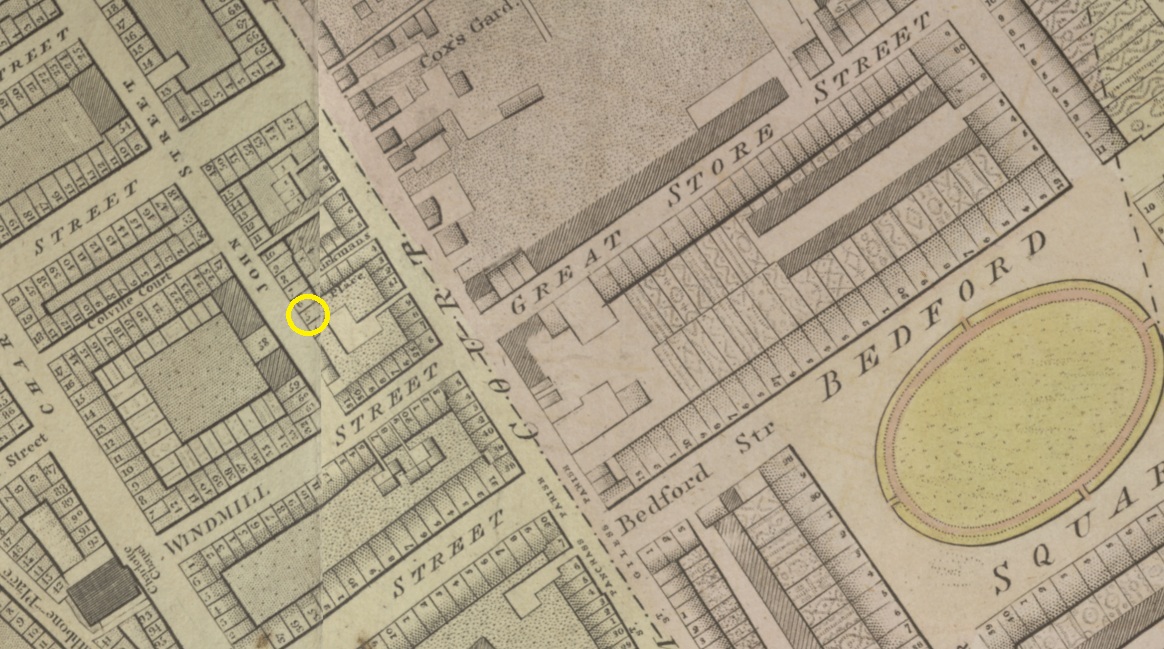
Alexandre was writing from 5 John Steet (now Whitfield Street) to the west of Tottenham Court Road where he was living as an émigré with his wife, Polly, and the couple’s two young children, and possibly also Polly’s mother, Ann (who worshiped at the non-conformist chapel on Tottenham Court Road, after whose preacher, George Whitefield, John Street was later renamed).
In the letter, Alexandre explained that, having been repeatedly urged by Macintosh to join the counter-revolutionary cause, he was preparing to travel to Normandy via Jersey to join the Chouannerie, a royalist insurgency that had begun in 1793. His decision to join the insurgency appears to have been driven at least as much by financial necessity as by political conviction. He and Polly were in straitened circumstances, and Alexandre evidently hoped that, despite the risks, joining the royalist forces in France might offer him a salary or a financial bonus of some kind. As he explained to George Macintosh, this was his “last way of getting something for my family”. “I know very well that the step I am going to take is surrounded by many dangers but my situation demands a desperate remedy.”
Whether Alexandre actually made the journey is not known, but in any event he had left it rather too late. The Chouan uprising was on its last legs and a formal truce was agreed on 6 July.
I am extremely grateful for having been able to see this letter, one of the very few pieces of family correspondence that appear to have survived.