“Calculation of the Quantity of Water raised by the Rope-pump as improved by Mackintosh Esqr.” c. 1782. Archives départementales de Vaucluse, 2 E Titres de famille 85, “Factures anglaises / 1769–1790”.
William Macintosh had a restless mind and a restless pen, and the networks within which his letters and ideas circulated were large and complex. For those reasons I was always slightly surprised that I had not been able to find any evidence that he corresponded with Joseph Banks, who was, in many ways, right at the centre of late-Enlightenment networks of epistolary exchange. It seemed almost inconceivable, given the flow of letters across Banks’s desk, and Macintosh’s penchant for firing off letters to the great and the good, that there was not at least one from Macintosh. There was, of course; I had just failed to spot it.
Yesterday I noticed that the Royal Society holds a 1782 letter from Macintosh to Banks, in which he submitted to the Society’s attention a model of a rope pump. According to the letter, the machine had been shown to Macintosh in Paris the previous winter by its inventor, a man “in poor circumstances”. Macintosh claimed to have encouraged the inventor to send a model of the machine to Britain, “where the ingenuity of an alien would meet with encouragement and reward”, but not having done so, Macintosh felt himself “justified in having the model made and improving upon it”.
This letter immediately explains the presence in Macintosh’s archive of a set of calculations (above) describing the “Quantity of Water raised by the Rope-pump as improved by Mackintosh [sic]”. For years I have wondered about that document—why it was there, what it related to—and the letter to Banks finally offers an explanation. I look forward to reading the letter in full when the Royal Society’s library reopens, but, for now, I can tick off one of the thousand-or-so outstanding questions I have about Macintosh, his world, and its traces.
A guest blog post by Dr Emily Hayes, Oxford Brookes University.
A summary of bread consumption by the occupants of Macintosh’s home (including by his servant, John Heffernan, the kitchenhands Joseph and Marianne, and Major Baggs, the first cousin of Philip Francis), c. 1786. Archives départementales de Vaucluse, 2 E Titres de famille 86, “1787”.
Le vin, c’est de la géographie liquide, wine is liquid geography, according to the French geographer, Érik Orsenna. At the online conference organised by the French Société de Géographie to commemorate the bicentenary of its foundation in December 2020, this quote was returned to again and again. A French man talking about wine, what a cliché… On reflection, perhaps it should not surprise.
As fans of the French TV drama Engrenages know, liquide in French signifies cash, specifically the sort that flows readily and becomes difficult to trace. I am not an economic historian, but William Macintosh’s financial affairs seem somewhat murky. Documents suggest that he may have owned shares in the Paris Water Company and derived an income stream from other bodies. Orsenna’s quote seems, to use a word that I know that I absorbed from Innes Keighren’s PhD, apposite. Some of that income, Macintosh invested in living and eating well in the south of France. The bills and receipts in his archives evidence this.
For example, the archives hold a 1785 bill for bottles of Château Margaux wine from the Bordeaux region to the west (Macintosh specified the 1781 cuvée), but also a barrel of everyday wine for drinking ‘with friends’. France has strong regional qualities. Being familiar with rural life in the country, and the standard practices of sociability and ways of integrating a community, I imagined that the latter might have been drunk with some of the many visiting workmen or tradespeople that we know Macintosh or one of his manservants, John Heffernan or Joseph, engaged with. Perhaps this wine was for an end-of-day aperitif. Perhaps sharing a glass of wine facilitated Macintosh’s language learning.
The papers also document a purchase of Châteauneuf-du-Pape wine, from a vineyard just to the north of Avignon. I myself bought a bottle (of white, as it is cheaper than the red) from this vineyard, located above the Rhône river valley, when on an archaeological dig near the town of Orange in my twenties. Later, back in the north of France, it was like uncorking pure sunshine.
Certain words are transformed when you read them. More than ink scrawled on paper, the fragrances of the objects to which they refer waft off the screen. Their tastes imagined and conjured in the mouth. A 1784 bill in the archive listed spices, cinnamon, cardamom, saffron as well as tea, coffee and sugar—foods that are today everyday ingredients in my own kitchen cupboard and handled so regularly that the mind cannot help but make the research experience more vivid.
A bill (undated) for metal work on a hook for hanging a lantern also included the cost of two bottles of tarragon vinegar. Such papers are often just scraps containing only a few scrawled lines, but upon reading them, imaginary conversations and promises being made as to how source good local products come into view.
Meat consumption appears to have been substantial with numerous receipts for beef, lamb, veal, hams and boiling hens. As well as oil, Macintosh’s cook used white lard, still a feature of Provençal cuisine today. Alongside these foods, the household expenses record the consumption of salads, artichokes and lemons.
Bread was a generously consumed staple. However, one 1784 document reveals household hierarchies: one type of bread for servants and another for les maîtres, the masters. These bills were important as they not only detail what was consumed, but also who consumed it. They, thus, provide insights into the numbers of servants, and their roles, who lived with Macintosh. They also show that visitors to the house were frequent—offering, perhaps, further evidence of French sociability.
In a failure of the imagination on my part, when I participated in archaeological digs, it became a pattern that I was more interested in historical sources rather than archaeological ones, and the contemporary landscapes and people around a site. The food especially drew me. Similarly, the wine and food consumption of Macintosh and his household is what stands out for me from the archival assemblage of bills, receipts and letters dating from the 1780s and 1790s. The occupants of Macintosh’s house enjoyed cream and a bill for the chilled cream deserts bavarois a la crème jumped off the screen, when I came across it.
Open Clam Shell, 1926, by Georgia O’Keeffe (1887—1986). Dallas Museum of Art, 2019.67.17.McD.
Les palourdes, or clams, also known in Provence as les clovisses pop up amongst the bills. The French author Marc Le Gros, in his book Éloge de la palourde (2009), or Ode to the Clam, claims that the clam is discrete and its inner life all ‘rythme, cadence’. The archaeological record shows that Mesolithic hunter and gatherers in what we now call Provence consumed clams millennia ago. On the dig that I worked on there, we cooked up huge pots of this cheap and readily available source of protein, an ideal quick, light meal in the warm south. Surely the mechanics of eating clams with your hands, sucking out the flesh and sauce from the shell and throwing out those which remain closed, do not change? Though it is unknown who in Macintosh’s household consumed this sea food, such familiar experiences seemingly transcend time and make one feel connected to the historical figures of study. The Macintosh papers compounded a longing in my bones and every cell of my body for France which returns with seasonal regularity, especially in the spring. And it was the lists, described here, of what would be called produits du terroir, locally sourced products, which did it.
A guest blog post by Dr Emily Hayes, Oxford Brookes University.
Cheeky Little Astronomer, 2013, by Yinka Shonibare RA (b. 1962). Royal Academy of Arts 14/2669.
Over the last few years I have intermittently assisted Dr Innes Keighren with his research into the Scottish plantation owner and trader William Macintosh who lived in and around Avignon during the 1780s and 1790s. The transcription and translation work that I undertook provoked some reflections upon my own European and cross-Channel upbringing, education and identity. What follows are some thoughts about my experience of working with multilingual archives, language learning and the teaching and learning practices of historical geography.
During my own recent research I came across a few lines in the British geographer, Halford Mackinder’s The Teaching of Geography andHistory: A Study in Method (1914), which resonated: in a little-known sensitive moment, Mackinder compared a child to a ‘little observatory’. A child who moves around a lot ‘sees many things but never sees thoroughly, in perspective and with correlation, the little universe which is accessible from any one home.’ A teacher’s aim, he said, was training a child ‘to obtain its bearings’ (p. 15). I often contemplate this claim and the implications that I interpret from it. Yet I am not sure that I agree with it.
Between the age of ten and sixteen I attended seven schools in three different countries. In 1988, when I was ten years old, my parents, in search of the good life or at least an escape from Thatcherite Britain, decided to move to France. As in the tiny school which is documented in the film Être et avoir (2002), my first French school was a small establishment in the village of Renescure in France’s northernmost region. My own CM2, or fourth junior year, class consisted of eleven pupils. We shared our class room, and teacher, with the ten pupils of the year group below (CM1). Somehow, Mme Delattre, our Maîtresse, taught both year groups at once. Enthused by the incipient European Community project that was then taking place, she had bravely agreed to take me on, a British girl with very little French, in what was already a complicated situation. She called me un pigeon voyageur, a messenger pigeon, because though I had just transferred from a UK school, I had also then recently, aged ten, spent four months at the American International School in Budapest in Hungary. There, before the Berlin Wall came down, I had a new form of mathematics, US spellings and what felt like a very alien American history and geography, drilled into me by new learning methods such as spelling bees and the dreaded public speaking. A discussion of the diverse teaching/learning methods and combined teaching of Histoire-Géo in France (excellent in my experience) might feature in a later post. At the time I just tried to keep on adapting.
Returning to my work for Innes on William Macintosh’s archives, the project has spotlighted a number of points about geography and language. The documents, many of them household bills and private correspondence, are often multilingual. They are written in both French and English and sometimes and to varying degrees, a mixture of both. Rather than solely or automatically pretentiously cosmopolitan, I believe that this was, and still is, reflective of daily life for many expatriates. Marina Warner brilliantly shows this to be the case in her fascinating and culturally critical memoire about her Anglo-Italian childhood in end-of-Empire Egypt, Inventory Of A Life Mislaid (2021, especially pp 221–34): expatriates speak, think with and, often, write in an idiosyncratic and unorthodox jumble of languages between themselves, and depending on the purpose.
As Innes’s previous blog posts have demonstrated, William Macintosh’s name appears in a spectacular array of variations across his extensive archive. My recent work on Macintosh suggested a relatively high literacy rate amongst the local tradespeople, many of them men, in and around Avignon in the final decades of the eighteenth century. Only one document recorded that the author signed their name with an ‘X’ because they could not write. However, it also showed that the many local tradespeople who billed Macintosh, related this foreign name to words that they already knew in French. For example, my favourite recently discovered variant of Macintosh was Mr le marquis decintosh, in a document written by Roubaud, a builder or estate manager, dated 7 September 1784. The writer attributed an aristocratic title to Macintosh because that is what he heard (rather than saw on paper) in the name ‘Macintosh’.
In relative terms, across all times and spaces, verbal and non-verbal methods of communication, rather than textual ones, have been the dominant means of negotiating human relations. In reading the documents, and again because of the many spelling variations in them, it was as if I started to hear the words on the page spoken by their authors. I wondered whether one of the bills had not been written by a French person (anonymous and undated) who was reporting the spoken words voiced by a person with a strong British accent as, for example, in the document which records Macintosh living in the Rue de lay garden meaning les jardins. Or was this just my imagination…?
The likelihood of spelling variations becomes higher and more common when you juggle phonemes, i.e. the blocks of sounds, in several languages. After six years of school in France, at sixteen, I discovered the hard way, that my written English was very bad. This was despite the fact that I was privileged to have access to thousands of books at home (as in Macintosh’s library, many of them were travel books, but unlike Macintosh’s library, there were also numerous histories of socialism and communism!) and that I was a keen reader. Over the years, as a family we increasingly spoke French or combined French and English. At school, I wrote and read in French (or German, Spanish or Latin), but never in English (and I did not study English as a second language either). The lesson then was that constant training and the need to regularly practice the multiple interconnected oral, aural and textual skills is necessary in the acquisition of language and, doubtless, other skills. For this a community is vital.
Over the years I have had to force myself to keep a running mental list of ‘false friends’ or the words which sound the same—or which have practically but not quite the same spelling—in English and in French. These include ‘government’ (English) and gouvernement (French); ‘parliament’ and parlement; ‘environment’ and environnement; ‘organization’ and organisation, ‘development’ and développement and ‘character’ and caractère, to name a few. For non-native language learners especially, homophone words which sound the same, such as ‘their’ and ‘there,’ are also problematic. Now, at the age of 42, I still have to pause, think and often check these spellings.
In growing up, the historical geographies of my own vocabulary—or vocabularies—have been brought into sharp relief. Reflecting my own travels and geographical movements, I am aware of where and when a specific word came on to my radar or when it became a word that I needed to use regularly. Having studied for an MSc in archaeology and environmental science jointly run by the Sorbonne and Nanterre in Paris, my knowledge of botany and, more broadly, the histories of French land management (and thus, by extension, geographical thought and methods) is in French (and to a lesser extent in Latin). The MSc dissertation that I wrote in French about organic residues and inclusions in pottery from the putative Empire of Mali in West Africa has also endowed me with a niche vocabulary that is organised, at least initially, in French in my mind. This recent work for Innes showed me that words such as vigne and vinaigre are ones that I know the spelling of in French first. I was stumped when it came to spelling their equivalents of ‘vine’ and ‘vinegar’, in English.
Yet, to that I would add, that although I have a mental habit of picturing in my mind’s eye equivalent words in several languages, one is never really fully bilingual in any language; it is a commonplace to say that language constantly evolves, but our individual linguistic needs constantly develop in additive and subtractive ways alike, according to opportunities of context, exposure and habit.
A further difference between French and English is that writing styles vary tremendously. This too can be seen in the Macintosh materials as letters and other documents penned by native French speakers (Le Seigneur de Ragnoni mentioned in Innes’s latest blog post, for instance) write sentences that are Proustian in length both in terms of the number of words that are set in motion and the clauses after clauses which pile up. A single comma does so many things in French. This style of writing was one that I too acquired and which, when I attempt to write in English and especially in academic English, I have to resist. Written short, staccato sentences and sharp syntax still rarely feel natural to me.
In undertaking more work on Macintosh, I was surprised to discover that the years that I grew up in la France profonde, or deep rural France, in both Les Hauts de France on the border with Belgium, and the Eure in Normandy, had provided an excellent basis for approaching Macintosh’s archive. Devoted to country life and day-to-day existence in small town France, as they are, many of the documents concern land management, household repairs and renovations. Others, which deal with horse management, suggest that Macintosh stabled up to five horses. Words such as licol (harness), selle (saddle), grenier à foin (hay loft) and maréchal-ferrant (farrier as distinct from ‘a smith’),and vermifuge (worming medicine) came naturally. As did brouette (wheel barrow) and chaux (lime white wash). The truth is that in rural France today you would still find, and your existence would likely depend upon, the goodwill and work of many in the very same tradespeople and suppliers as those documented in Macintosh’s archive.
The documents suggest that Macintosh’s understanding of French, and written fluency in it, was excellent. Where, when and with whom he initially learned it is, I think, unknown—Innes has mentioned to me that Macintosh had not yet mastered the language when he first arrived on the largely Francophone island of Grenada in 1763. However, textual traces, nevertheless, constitute only partial evidence. Macintosh may have used a dictionary when writing. He may have found gaps in his vocabulary and frequently had to learn new words. Written documents rarely record regional accents. What did Macintosh’s spoken French sound like? How well did he handle the formal and informal registers of French speech? Did he have a Scottish accent? It is likely that he did not speak French with what is called l’accent du sud or the ‘southern accent’. So, I ask myself what Macintosh’s life as an expatriate and, perhaps, the communication problems he experienced, were really like.
As Hungary, and then France (and later Japan and other places), did for me, even short periods abroad can mark you profoundly and dramatically change the course of your life. I therefore wondered whether Macintosh ever considered Avignon as home or as a home. Was he ever accepted as a local or did he remain an outsider both in his mind and in those of those around him? If so, then how did he feel about this? What insights into the idea of a ‘universal’ human nature, and to which he adhered, did this give him? How did a decade or so in southern, rural France change him? What linguistic, or other, legacy did he leave in Avignon? How did he change the people and the place he eventually left behind?
My own cross-Channel education and life is inscribed in my mind and its shaping, and is manifested in my writing and spoken language in French and English. This is the basis for my feeling disposed of the English language, but also of my belief in regularly correcting students’ spelling mistakes: to take writing and spelling seriously is to take yourself seriously; to be able to write well and to spell correctly is to be taken seriously in life. And yet I still make mistakes… In addition, this makes me aware of the fact that I am stronger at learning to speak languages than I am learning to write them.
There are also broader, and perhaps more important, points to make here about cultural hierarchies and the over-privileging of text-based knowledge, histories and communities as well as particular languages and registers of language.
As many readers will know, in 1994 France ratified the Toubon law which stipulated that only French words should be used in government, parliamentary and public communications. This protectionist measure was, it was claimed, taken as a form of cultural conservation. Today, at a time when there continues to be concern about, as well as rampant resistance to, anglophone dominance in academia, the Macintosh archive evidences, across a number of human and spatial scales, the longevity, and pre-twentieth-century history, of the international hybridization and intermixing of the French and English languages.
Additionally, the research on Macintosh suggests the urgency of writing, but also of relocating within existing histories, what are called popular histories. My own work on popular geography and historical geographies of magic lantern practices indicates the need for this reconfiguration. Across the centuries-long and global histories of magic lantern use, and across Macintosh’s lifetime, most people around the world did not read or write. However, cross-cultural communication took place because of the common referents of a stock of shared mental images, emotions and sensations.
Though I lived, studied and worked in regions of northern France and Paris, many aspects of Macintosh and his retinue’s late eighteenth-century existence in the south of the country feel eerily familiar and little different from what I have known from the 1980s on. Here French food-related trades are especially revealing as the archives attest to the fact that Macintosh treated himself to the finer things in life. In another guest blog post I would like to discuss the archive’s feast of flavours, dishes, and words in relation to haptic and sensory historical methods.
I want to conclude by referring back to the image of the sculpture titled ‘Cheeky Little Astronomer’ (2013) by the British-Nigerian artist, Yinka Shonibare (b. 1962), as well as the quote from Mackinder at the top of this post. Further research on what this might have meant in terms of Mackinder’s own education is necessary here. The ‘little observatory’ of a child does, undoubtedly, need some fixed coordinates, but these reference points do not have to be geographical or, rather, the topographical, cultural and linguistic scale of these references does not have to be narrow, static or singular. The celestial and earthly constellations which astronomers, but also historical geographers, observe and to which they affix knowledge are incessantly moving. Coordinates can therefore be values which transcend, and reflect what lies beneath, the trappings of time, place, people and language.
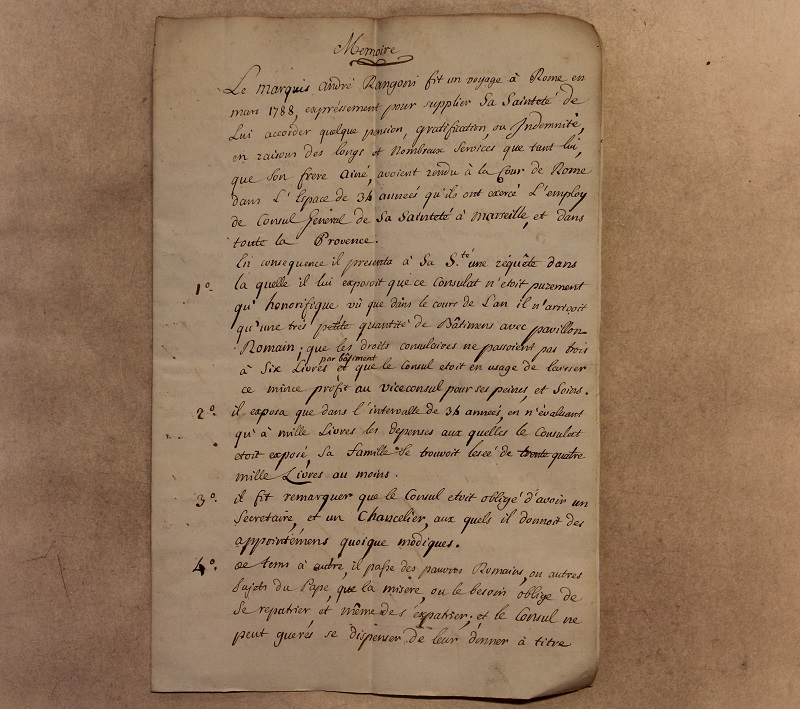
I have long known that Macintosh visited Rome (he bought several books there in late 1790), but the details of his visit have remained sketchy. Thanks to some recent translation work done for me by Dr Emily Hayes of some of the French-language material in Macintosh’s archive, I am beginning now to get a better sense of what might have prompted the visit.
“Memoire” by André Rangoni, c. 1790. 2 E Titres de famille 86.
One document in particular, written by André Rangoni, the Pope’s Consul General in Marseille, is particularly revealing. Emily’s summary of the document shows that the memoir itself is primarily a request to Rome to increase the allowance paid to Rangoni (and to his elder brother) on account of various out-of-pocket expenses incurred in undertaking their duties—hiring additional staff, issuing poor relief, providing hospitality to visiting dignitaries, etc., etc.
[This paragraph was revised in June 2025 to reflect an updated understanding of the source material]. Rangoni’s memoir, seemingly written in anticipation of Macintosh’s visit to Rome, expresses his hope that Macintosh, in his prospective conversations with the Pope and Cardinal Secretary of State, Francesco Saverio de Zelada, will recommend him for an “honorable and lucrative job [un emploi honorable et lucratif], on account of his zeal and honesty. The memoir notes that Rangoni had already discussed such a job with the Pope’s nephew, “la Sainteté Monsr. le Duc Braschi“.
Some of the material I looked at in the British Library last week offers further details about Macintosh’s experiences in Italy, but it will take some time to piece it all together into a coherent narrative. While I am very keen to know more (did he, as Rangoni hoped, have an audience with Pope Pius VI?), I am having to resist the strong temptation to extend my search to the Vatican archives where, undoubtedly, there might be something to dig up on Macintosh. Macintosh’s world is one seemingly without end, and I have to leave some of its corners for others to explore.
Today marks the midway point of my (extended) Leverhulme Trust Research Fellowship: eight months down, eight to go. This is a good moment, therefore, to take stock of where I am and what I still need to do. As much as it might feel to me like I have got nowhere and that I still have an infinite amount of work remaining, I know this is an illusion; I have probably made more progress in the last eight months than I have in the preceding eight years. Most significantly, perhaps, since mid November I have written, across sixty-two days, a little over 50,000 words (inclusive of notes). The problem is, however, that all those words relate to what was, in my original plan (see above), a single 15,000-word chapter dealing with Macintosh’s time in the Caribbean. In the process of writing, that chapter has not only expanded in length, but has, in fact, split into two chapters, the second of which is still nowhere near being finished!
In addition to the book’s introduction and conclusion, I still have about four and a half empirical chapters to write. If my experience in writing the first chapter(s) is anything to go by, these are all likely to be longer than I had planned and may even multiply in unexpected ways. Although a lot of these words will almost certainly hit the cutting-room floor at some point in the future, I am finding it difficult to make those editorial decisions as I go—I feel I have to write this out in full first in order to understand the material before going back to narrow and tighten the focus at a later date. The reason I think this is so is two-fold: 1) the near-total absence of any secondary literature on Macintosh means that I cannot rely on other sources to do the work of summary and explanation for me and 2) because the book is driven by the empirical goal of understanding Macintosh’s world and words, rather than by a more narrowly defined conceptual contribution, it is much more difficult to draw a boundary around what material matters and what does not. In that respect, this book is so much more difficult to write than those I have worked on in the past: there is, in effect, no body of existing literature and the scope is potentially without limit.
All that being said, I would very much like to be able to have a first draft of all the empirical chapters by the end of the calendar year. I honestly do not know if that is realistic, but I know that if I return to my normal duties in January next year with a lot of empirical research and writing still to do, it will be the work of years rather than months to finish.
The BL back to life.
I was very fortunate this month to secure (in the great academic lottery of ticket allocations) a couple of slots at the British Library and the National Archives. This has allowed me to finally follow up on a number of archival leads I have been waiting to chase for many months. The material in the British Library relates to Macintosh’s time in India and his years as a counterrevolutionary in Switzerland, and that at the National Archives to his time in the Caribbean. While I still need to digest much of this material—the short period allowed for visits (3 hours at the BL, 5 hours at TNA) means that I prioritised photographing material rather than transcribing it—I was pleased to find confirmation, in a letter from Macintosh to Charles Jenkinson, 1st Earl of Liverpool, that he (Macintosh) was the author of a 1781 pamphlet, The Origin and Authentic Narrative of the Present Marratta War. Although I had known this was a possibility, it is really helpful to have proof of it. In the same letter, Macintosh also provided Jenkinson with “the unarranged production of my enquiries during some months residence & travels in India” (i.e., an early version of what would become Travels in Europe, Asia, and Africa).
This month I have also had the invaluable assistance of Dr Dean Bond and Dr Emily Hayes—working as freelance researchers—in dealing with (respectively) German and French sources. I have written before about how this project depends upon the advice and help of a veritable village of other scholars and that has been particularly true with respect to dealing with non-English sources. Dean has kindly been looking through German reviews of Travels (in both its English and translated versions) and Emily has been working through the material from Macintosh’s time in Avignon, mainly the very many receipts he kept from those years. Meanwhile, Jaz Bigden (who is undertaking a placement as part of the MSc in Global Futures at Royal Holloway) is working on an inventory of Macintosh’s first letterbook and my dad, Alex, has been continuing to lend his assistance, gratis, with various transcription tasks. It is no exaggeration to say that I could not do this project without their help.
It’s a source of wonderment and some embarrassment that this blog has reached its ninth birthday. On the one hand, I’m really glad to have kept it going for so long—it’s been helpful as a record of what I have done and still need to do, as a venue for the first rough draft of later writing, and, as a mechanism by which to reach an audience, it’s allowed me to connect with lots of interesting people. On the other hand, the blog’s birthday is a reminder of quite how (embarrassingly) long this project has been on the go—it was already a year old at least by the time I started the blog. I am, in that respect, now ten years or so into my work on Macintosh and it may yet be another three or four before the planned book finally materialises.
I have been very fortunate throughout the project not to have come under institutional pressure to prioritise other research projects that might offer a quicker return, even when—year after year—I failed to secure funding for this one. Given the ever-changing landscape of higher education and the growing emphasis on “generating income” (through applications for challenge-led research funding, for example), I cannot overstate how important it has been for this project that I have never (yet) been compelled to prioritise income generation over intellectual curiosity. I do worry, however, that the financial difficulties that the higher education sector is now experiencing as a consequence of the pandemic and lack of state support will mean that this sort of work—the slowest of slow scholarship—will become increasingly untenable and our individual priorities as academics will be recalibrated primarily along financial lines, rather than lines of intellectual inquiry.
Thanks to the support of the Leverhulme Trust, I have, however, made more progress in the last seven months than I have done in the previous half decade (even taking into account the impact of two lockdowns and months of home-schooling). The night-and-day difference that being relieved from teaching and administrative duties has made to my work on Macintosh is palpable, and it confirms something that I had often felt but had not quite been able to illustrate: that the time available for research (what is often pejoratively referred to as “unfunded research”) has, year on year, shrunk. When I was working with Charlie Withers and Bill Bell on writing Travels into Print, I remember being able typically to devote a day and a half each week of term to the task. Over the course of a term, I would have written a chapter. Viewed in retrospect, that situation seems barely believable. For at least the last five years or so, I have almost never been able to do any research or writing during term time at all and the precious remaining windows of the Easter and summer breaks have gradually, almost imperceptibly, been eroded by marking, meetings, and administrative tasks that seem never to let up. These windows are, of course, also the only time of the year when it is really possible to take annual leave. These observations are not in any sense new—every academic will be familiar with them—but the cumulative effect of changes to workload and its distribution across the academic year has really been brought home to me as a consequence of the fortunate position I now find myself in.
In early February I came to the unwelcome (although entirely obvious) conclusion that I was not going to be able to deal with all of Macintosh’s time in the Caribbean within a single chapter—Chapter 2—as I had originally planned. This month I have come to the equally obvious and equally unwelcome realisation that I am unlikely to be able to deal with it fully in two. Chapter 3, which I added to my writing plan last month, is expanding in all sorts of interesting ways as I continue to dig, read, and write and, although I am now at the half-way point in terms of acceptable word length, I am only just up to the winter of 1769–70 in the chronology, during which time the argument over French Catholic participation in Grenada’s government really comes to a head in the newspapers, printshops, taverns, and administrative offices of London. The figure of Thomas Hollis—whose fascinating and bizarre diary I read for the first time this month—looms large over these proceedings. While it has long been known that Hollis, a libertarian and fervent anti-Catholic, took an active interest in the debate over French Catholic participation in Grenada and Quebec, the full scale of his involvement hasn’t previously been written about, so it’s nice to be able to reveal this properly.
As it currently stands, I am hoping to be able to get to the financial crisis of 1772 (which was precipitated by Macintosh’s friend and financial supporter, Alexander Fordyce) by the end of Chapter 3, and to wrap up Macintosh’s Caribbean experiences in the first third of Chapter 4. I think this relative ballooning of chapters, in length and number, is a consequence partly of just how much there is to say and partly of the fact that there is next to no secondary literature on Macintosh that can do the job for me. Even then, I know that there is a huge amount of material from this period that I won’t be able to do more than hint at—material that I know will be of interest to historians of the Ceded Islands, but which really lies outside the core focus of the book. I keep having to remind myself that I can’t follow Robert Caro’s example and turn this into a five-volume epic.
The creeping sense of doubt and anxiety about ever being able to get to the end of this book has been allayed by three positive developments: 1) the reopening of schools on 8 March, which has allowed me to step back from my part-time role as home educator; 2) the prospect of the British Library and National Archives reopening in April, and 3) that the Leverhulme Trust has approved a request to extend the period of my fellowship to the end of the calendar year. This last piece of news is, frankly, an incredible privilege and something for which I am profoundly grateful. Having the chance to make up for time lost to home-schooling and the closure of libraries and archives is a huge relief, but I am acutely aware of what a privilege it is; so many of my colleagues (as well as my other half) whose research has been impacted in just the same way won’t have the same compensating opportunity.
Given recent experience, I am now rather reluctant to set out definitive goals for April (other than to take some proper time off during the school holidays), but I hope to be able to get back to the British Library to consult some manuscript material that I need in order to understand more fully the circumstances that led Macintosh to India in the first place, and to move Chapter 3 substantially closer to a conclusion.
Archives départementales de Vaucluse, 2 E Titres de famille 85, “Factures anglaises / 1769–1790”.
The silver lining of having spent so long working on Macintosh, is that it has become easier to spot the significance of particular items—clues that would have meant virtually nothing to me at the beginning of the project, now jump out at me. This is the case, for example, with the above receipt, the text of which reads
“Received this 5th Day of March 1782 of Mr Thompson the Sum of Seven Pounds Nine Shillings in full for Printing &c a Pamplet [sic] entitled Second Letter to Mr Jenkinson”
I had never heard of this pamphlet before today, but there are some tantalising clues that it may have been written by Macintosh, namely:
1) it was published by John Murray (who also published Macintosh’s Travels in Europe, Asia, and Africa the same year);
2) the recipient of the pamphlet’s “letter” was Charles Jenkinson, to whom Macintosh sent a letter the previous year, 1781 (which I have not yet been able to read due to the closure of the British Library);
3) the pamphlet (which I have not yet read because it appears not to have been digitised) was published anonymously, but was signed “A citizen of the world”, an epithet Macintosh often used to describe himself;
4) the “Thompson” referred to in the receipt, may have been William Thomson, who was the Grub Street editor employed to add a literary polish to Macintosh’s Travels.
Clearly this all requires a lot more digging, but it would be wonderful to be able to add another example of a Macintosh-Thomson-Murray collaboration in order to put the production of Travels into wider context.
I have taken a temporary step back from writing in order to take another systematic trawl through the more than 4,000 archival photographs I have in an effort to make sure that I don’t miss anything important when I do return to writing. The difficulty, of course, is knowing what is important and where important information is likely to be. Each time I take such a trawl, I learn new and surprising things, which reinforces the anxiety that I can never understand Macintosh fully unless I read every scrap of paper in his archive—an unrealistic task that would take me another ten years and would drive me to distraction!
One such discovery today was made in the large folder of receipts which offer an always-interesting snapshot into the purchasing habits of Macintosh and his family. One receipt in particular—for ribbons and gloves purchased by Macintosh’s wife, Ann, in 1778—is fascinating for what it reveals about the nature of the relationship between the couple.
Archives départementales de Vaucluse, 2 E Titres de famille 85, “Factures anglaises / 1769–1790”.
At the bottom of the receipt is a short narrative, dated 2 March 1781 and composed at the point at which Macintosh settled the bill. It reveals that he and Ann had, at this point, “been near four years separated, by mutual consent”. I had long suspected this must be the case, but I had never before found direct evidence of the fact (beyond Ann being described as a widow, even before Macintosh’s death). It is helpful to have some evidence of the toll Macintosh’s political activity and global mobility exerted on his family, but I do wonder what other revelatory snippets are still there, waiting to be discovered.
If January bucked the trend of months seeming to zip past in the blink of an eye, February has very much marked a return to business as usual. I can’t quite believe that four working weeks have passed and that it is now six months since I began my Fellowship with the Leverhulme Trust. Yikes!
As ever, this month has been a mixed bag: I feel like I’ve made good progress in some areas and have stalled in others. At the end of January, I set myself the goal of finishing my account of Macintosh’s two decades in the Caribbean by the end of February. That goal was, I now realise, hopelessly optimistic. As I neared 30,000 words of the book’s first empirical chapter, I had only got as far as 1768. I realised that, as I was only just over the half-way point in terms of what I wanted to say about Macintosh’s formation as a political actor in the Caribbean, I needed to split the chapter. Now, I have one chapter (25,863 inclusive of notes) that covers the period between Macintosh’s birth in 1737 and his return to Britain in 1768 to lobby the government over the rights of French Catholics in Grenada and attempt to unseat Robert Melvill as the island’s governor. The second empirical chapter (currently 5,287 inclusive of notes) will follow that story in London and then return with Macintosh to Grenada to witness the aftermath of that lobbying.
I feel happier now that I have restructured this element of the book—in many ways it is endlessly fascinating, but it is also really quite important in terms of understanding how and why Macintosh became drawn into political activity. At the same time, I have become aware that my productivity, if measured crudely in words per day, has been declining month on month. This is, I think, due to a combination of factors. The first, and most significant, is the time invested (20 hours per working week) on home schooling since the beginning of January. There are simply not enough hours in the day to write a book and educate a five-year-old, and the level of fatigue has been creeping up as a result. Still, my phonics and number bonds have come on in leaps and bounds.
Flattening the curve (but in the wrong way).
The second issue is that, as the complexity of the social and political contexts in which Macintosh was involved increases, I am spending proportionally more time researching than writing. This was especially true this month when, earlier than I had expected, I needed to start understanding and writing about the politics of the East India Company. The learning curve has been a steep one, but I think it has allowed me to understand Macintosh and his milieu more fully than I had before and to identify the centrality of Lauchlin Macleane to Macintosh’s activities in the West Indies and British India during the 1770s.
Very early in my work on Macintosh, I had read Emma Rothschild’s The Inner Life of Empires: An Eighteenth-Century History (2011), ostensibly for a footnote reference to Macintosh that it contained, and was totally blown away by it—I thought it was wonderful. That book follows one Scottish family—the Johnstones—across Britain’s eighteenth-century empire. An Infinite History is also a family story, but one that focuses on five generations of a family from Angoulême in the south west of France (all descendants of one illiterate woman, Marie Aymard) from the eighteenth to the twentieth century. Although the source material for An Infinite History is different—drawing largely from civic records and notarial acts and less from correspondence—it is equally compelling and in many ways quite beautiful. (I can also recommend the audiobook, which is excellent).
Macintosh serves as an interesting connection between Rothschild’s books, and the families she discusses; he was a friend of one Johnstone brother (Alexander) and a business partner of another (William) and was involved in Grenadian politics with the man who employed Marie Aymard’s husband, Jean-Alexandre Cazaud. Six degrees of separation, indeed! Together, Rothschild’s books represent the kind of history I aspire to write, but to which I know I will never come close. It matters, though, to have something to aim towards.
Caro’s book, on the other hand, is inspiring in a slightly different way. In his reflections on the lengthy (indeed, very lengthy) process of writing two biographies—one on the roguish “master builder” Robert Moses, the other on Lyndon B. Johnson—Caro makes the ultimate case for slow scholarship. Part of me wishes it were possible for me to follow his example, and to invest another decade in turning every page of Macintosh’s archive and in chasing down every lead, but part of me realises that my work, and this book I am writing, cannot be definitive. It can be as good as I can make it in the time and with the resources I have, but should start a conversation about Macintosh, not be the last word on him.