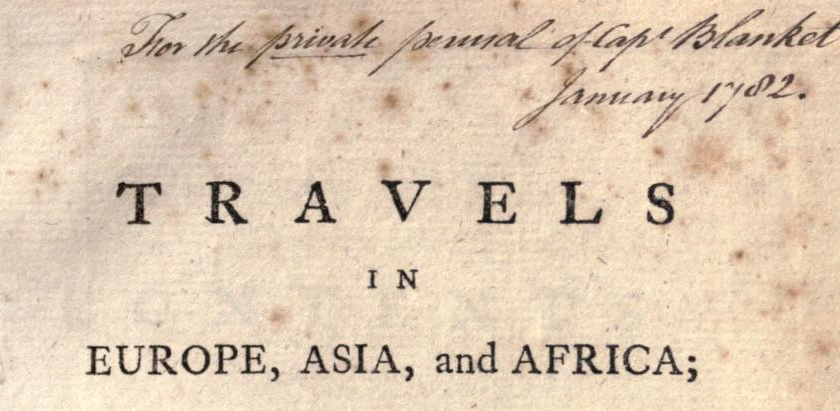
The end of the exam term has allowed me to return, somewhat dazed and confused, to the book manuscript. Although I had tried my best to keep the research going during term time, it has been several months since I did any real writing and restarting the task has proved to be quite slow going. Inadvertently I had left the manuscript, just before Christmas, at a difficult-to-resolve juncture: the point in 1777 where Macintosh made the decision to embark on his “Eastern scheme” and to lay the groundwork for his journey to India. I didn’t know then, and am still now trying to understand, what the “Eastern scheme” actually involved (whether in Macintosh’s imagination or in reality) and until I can get that question resolved to my satisfaction, it is difficult to move the narrative forward.
I made progress of a sort this week in eliminating some of the possible explanations for the “Eastern scheme” and, in the process, cleared up some misidentifications of Macintosh that have appeared in the secondary literature. I have written before about the way Macintosh has been misrepresented or misunderstood as a consequence of confusion over or conflation with others who shared the same or a similar name. Such a situation occurred in relation to a “Mr Macintosh” (or “Mackintosh”) who, in late 1776, sailed for India in the Rippon with a series of letters for Warren Hastings from his agent in Britain, Lauchlin Macleane. I knew from evidence in Macintosh’s archive that he didn’t leave Europe for India until 1778, but I was not sure exactly how the two men had come to be conflated.

Perhaps the first conflation of Macintosh with “Mr Mackintosh” of the Rippon occurred in Henry Beveridge’s The Trial of Maharaja Nanda Kumar (1886), where he records that Macleane’s letters were taken out to Hastings “by Macintosh”. Although Beveridge identifies this Macintosh as the author of Travels, he acknowledges the fact that—according to Travels—its author “did not arrive in India till 1779”. “I still think,” he went on “that the Macintosh referred to by Hastings must be W. M., for [Joseph] Price calls the latter an intimate friend and fellow-labourer of Colonel Macleane”. In this respect, the confusion is perfectly understandable: what are the odds that Macleane would be working closely with two Macintoshes, both of whom travelled to India around about the same time?
Years later, and apparently independently, Lauchlin Maclean’s biographer—James N. M. Maclean—made the same error in conflation, noting that Macintosh had been “sent out to India as his [Macleane’s] special messenger to Hastings in November, 1776”. In this case, Macleane’s biographer had at least consulted the original correspondence, in which he would have seen Macleane’s note to Hastings concerning the bearer of his letters: “Mr. Macintosh promises all diligence and Dispatch with zeal & fidelity. He is recommended to your Protection” (13 November 1776; BL Add Ms 29317, f. 461r).
So, who was the Macintosh who sailed with the Rippon in November 1776? The best clue we have comes in a letter sent to Hastings from John Macpherson. In that letter (30 August 1778, BL Add MS 29141, f. 342v), Macpherson explained to Hastings that it had been him who had introduced “Mr. Mackintosh” to Macleane, “in order to place him in the line of a better fortune, than had attended the early part of his life”. As Macpherson explained, “In the success of that poor fellow, I am much interested”. It is possible that this was the same Mackintosh whom Laurence Sulivan had recommended to Hastings in 1773, when he wrote of a “Mr. William Mackintosh, who was in Bengal, & other parts of India, some Years, in the Shipping way; and now returns to follow the same Employ” (27 January 1773; BL Add MS 29133, f. 345r).
As the number of William Macintoshes continues to mount in my research, I can’t help but think that an interesting book could be written on their simultaneous, but different, experiences of the eighteenth-century world. What would it look like to write a history of that period from a prosopographical perspective, tracing the converging and diverging lives of those who shared a name? I shan’t allow my self to get distracted; one Macintosh is more than enough to keep me going!
By (yet further) coincidence, the Rippon was commanded on its eventual return voyage to Britain in 1780 by Captain John Blankett, to whom Macintosh would go on to send a dedicated copy of Travels upon its publication.