Author Archives: Innes Keighren

About Innes Keighren

Professor of Historical Geography at Royal Holloway, University of London.

Would the real Mr Macintosh please stand up?

The end of the exam term has allowed me to return, somewhat dazed and confused, to the book manuscript. Although I had tried my best to keep the research going during term time, it has been several months since I did any real writing and restarting the task has proved to be quite slow going. Inadvertently I had left the manuscript, just before Christmas, at a difficult-to-resolve juncture: the point in 1777 where Macintosh made the decision to embark on his “Eastern scheme” and to lay the groundwork for his journey to India. I didn’t know then, and am still now trying to understand, what the “Eastern scheme” actually involved (whether in Macintosh’s imagination or in reality) and until I can get that question resolved to my satisfaction, it is difficult to move the narrative forward.

I made progress of a sort this week in eliminating some of the possible explanations for the “Eastern scheme” and, in the process, cleared up some misidentifications of Macintosh that have appeared in the secondary literature. I have written before about the way Macintosh has been misrepresented or misunderstood as a consequence of confusion over or conflation with others who shared the same or a similar name. Such a situation occurred in relation to a “Mr Macintosh” (or “Mackintosh”) who, in late 1776, sailed for India in the Rippon with a series of letters for Warren Hastings from his agent in Britain, Lauchlin Macleane. I knew from evidence in Macintosh’s archive that he didn’t leave Europe for India until 1778, but I was not sure exactly how the two men had come to be conflated.

An early conflation of William Macintosh with “Mr Macintosh” of the Rippon, from H. Beveridge’s The Trial of Maharaja Nanda Kumar, A Narrative of Judicial Murder (1886).

Perhaps the first conflation of Macintosh with “Mr Mackintosh” of the Rippon occurred in Henry Beveridge’s The Trial of Maharaja Nanda Kumar (1886), where he records that Macleane’s letters were taken out to Hastings “by Macintosh”. Although Beveridge identifies this Macintosh as the author of Travels, he acknowledges the fact that—according to Travels—its author “did not arrive in India till 1779”. “I still think,” he went on “that the Macintosh referred to by Hastings must be W. M., for [Joseph] Price calls the latter an intimate friend and fellow-labourer of Colonel Macleane”. In this respect, the confusion is perfectly understandable: what are the odds that Macleane would be working closely with two Macintoshes, both of whom travelled to India around about the same time?

Years later, and apparently independently, Lauchlin Maclean’s biographer—James N. M. Maclean—made the same error in conflation, noting that Macintosh had been “sent out to India as his [Macleane’s] special messenger to Hastings in November, 1776”. In this case, Macleane’s biographer had at least consulted the original correspondence, in which he would have seen Macleane’s note to Hastings concerning the bearer of his letters: “Mr. Macintosh promises all diligence and Dispatch with zeal & fidelity. He is recommended to your Protection” (13 November 1776; BL Add Ms 29317, f. 461r).

So, who was the Macintosh who sailed with the Rippon in November 1776? The best clue we have comes in a letter sent to Hastings from John Macpherson. In that letter (30 August 1778, BL Add MS 29141, f. 342v), Macpherson explained to Hastings that it had been him who had introduced “Mr. Mackintosh” to Macleane, “in order to place him in the line of a better fortune, than had attended the early part of his life”. As Macpherson explained, “In the success of that poor fellow, I am much interested”. It is possible that this was the same Mackintosh whom Laurence Sulivan had recommended to Hastings in 1773, when he wrote of a “Mr. William Mackintosh, who was in Bengal, & other parts of India, some Years, in the Shipping way; and now returns to follow the same Employ” (27 January 1773; BL Add MS 29133, f. 345r).

As the number of William Macintoshes continues to mount in my research, I can’t help but think that an interesting book could be written on their simultaneous, but different, experiences of the eighteenth-century world. What would it look like to write a history of that period from a prosopographical perspective, tracing the converging and diverging lives of those who shared a name? I shan’t allow my self to get distracted; one Macintosh is more than enough to keep me going!

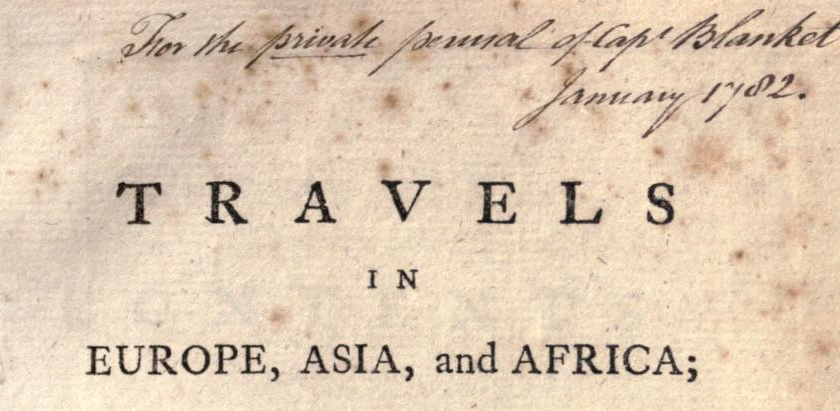
By (yet further) coincidence, the Rippon was commanded on its eventual return voyage to Britain in 1780 by Captain John Blankett, to whom Macintosh would go on to send a dedicated copy of Travels upon its publication.

Inscription to Captain Blanket.t
Inscription to Captain Blankett.

10 years on

Monday marked the 10th anniversary of this blog (yikes!), and found me on a train to Rome. Although this was not a research trip, I was nevertheless following in the footsteps of William Macintosh, who visited the city in 1790 possibly for an audience with the Pope.

Like any dutiful tourist, I visited the Vatican and, in passing the entrance to the Apostolic Archive, did wonder idly if Macintosh’s presence might be recorded somewhere in there. It is, however, an avenue I have decided not to explore in the hope of actually being able to finish the book one day.

While in Rome, I received the very welcome news that an application I had made for a research sabbatical in the first term of 2022/23 had been approved. This is a huge relief, and a terrific privilege (since sabbaticals are awarded less routinely these days), and will give me a pretty clear run at the book from late June until Christmas.

Slowly, slowly…

At the end of my Leverhulme Fellowship in December, I set myself the challenge of keeping progress on the book moving along (no matter how incrementally) during term time, by blocking out time in my diary for the task. Somewhat to my surprise I have, so far, managed to stick to that plan and this is the fifth Friday in a row that I have been able to devote (wholly or partly) to Macintosh. In some ways this should not feel like such an achievement, but over the last five or so years I have found it increasingly difficult to do anything in term time other than frantically spin the plates of teaching and administration. Creating time for Macintosh has meant squeezing other tasks into the late evenings. It is doable, but it does not feel very sustainable!

My focus this year has fallen on trying to better understand and contextualise Macintosh’s geographical, economic, and political transition from Caribbean planter to traveller in India. His own archive is patchy during this period and I have had to cast the net much further to try to understand what was going on and how particular networks of friendship and patronage set Macintosh off in this new direction. His longstanding friendship with Lauchlin Macleane was particularly important in this respect and I have gone back to the work of his biographer, James N. L. Maclean, to better understand the relationship between Macintosh and Lauchlin Macleane. Macleane’s biographer is excellent on Macleane but, as I have written before, gets Macintosh completely wrong because he confused and conflated him with another individual with a similar name. Nevertheless, the work of James N. L. Maclean is really central to my understanding of this important period of transition in Macintosh’s life.

For a long time I have been meaning to read Maclean’s master’s thesis, which was a follow-up to his published biography of Lauchlin Macleane, and covers in detail the final four years of Lauchlin’s life, when he was working as agent for Warren Hastings. Not being able to find the time to get to Oxford to read the thesis in the Bodleian, I have spent the last couple of weeks tracking down Maclean’s literary executor to get permission to have an electronic copy of the thesis made. The task allowed me to play detective and, using the acknowledgements in Maclean’s PhD thesis, I was eventually able to identify and contact his literary executor, who has been kind enough to give permission for the master’s thesis to be reproduced (and eventually hosted on the Oxford University Research Archive).

Lauchlin Macleane was at the centre of East India Company politics in the 1760s and 1770s, and it was through him that Macintosh acquired the assistance or patronage of Company directors. Especially important in this respect was Laurence Sulivan, who was— at intervals—a director, Deputy Chairman, and Chairman of the Company. In letters to his son, Stephen, Sulivan writes interestingly about Macintosh’s motivations for going to India. Sulivan and his son tried to keep their correspondence secret by using a cypher: Macintosh was “Prime”, his friend John Townson was “Tracey”, and the Nabob of Arcot (Lacuhlin’s sometime employer) was “Job”. Sulivan’s letters to Stephen are held privately and I am very fortunate that their owner has agreed to let me consult them later this month. Without them I do not think I would be able to be definitive about what exactly set Macintosh on his course to India.

As ever, there is a lot still to do. Sometimes it feels like there is everything still to do, but writing this book is an attritional process and slowly, slowly, little by little, it will get done.

December in review

The end of the beginning.

Today is the 300th (and final) working day of my Leverhulme Trust Research Fellowship. Although I can’t quite escape the thought that I have only just got going with the book, I find to my surprise that I have actually accumulated 108,450 words (including notes and bibliography). The nature of academia is, of course, always to lament the fact that more could have been done and that anything less than total completion of a project reflects some kind of failure. Anticipating that feeling, I began my Fellowship by creating a diary, in which I listed what I had done each day, whether that was reading, writing, editing, researching, or dealing with administrative tasks. I certainly found it a helpful routine in combatting existential crises over productivity!

300 working days condensed (red indicates periods of lockdown and/or homeschooling).

I have progressed the book, roughly speaking, to the spring/summer of 1777—the period just before the narrative of Travels in Europe, Asia, and Africa begins. Understanding Macintosh’s transition from Caribbean planter to traveller in India has proved taxing given the fragmentary, contradictory, and often deliberately clandestine nature of the surviving evidence, but I finally feel I am beginning to get to grips with it. Without question the most difficult part of the project is writing without the benefit of a foundation of existing scholarship—there is no empirically detailed but acritical Victorian hagiography of Macintosh for me to draw on, and every “fact” of Macintosh’s life has to be wrestled from primary sources. The consequence of this is that it’s difficult to know what twists and turns the narrative of his life will take next. It’s a little like driving towards a distant city in thick fog—the bright lights of the destination are just about visible, but you can’t see what’s coming next.

Having covered the first 40 years of Macintosh’s life, I have 36 to go. There is a vast amount of research and writing ahead, and still 21 months until the book needs to go to the publisher, but—in this moment at least—I feel hopeful that I’ll get there.

November in review

The Public Advertiser, 21 June 1777.

For much of the past year, as I have been writing Macintosh’s life, I have been thinking about his family: Ann, his wife, who nearly died following a miscarriage in Antigua in 1762; Betsey, the apple of her father’s eye, who eventually became estranged from him; Polly, strong-willed and independent, who gave Macintosh granddaughters and ever-expanding lines of descent in nineteenth-century France; and William, the boy who may have been adopted, who could never settle at school, and who seems to vanish from history after 1782. Macintosh’s relationship with Ann, in particular, has fascinated me, partly because it is so difficult to follow in the sources that remain. In the last month, however, I have finally been able to trace its end. Macintosh and Ann, long separated by the Atlantic, met in London in the spring of 1777 to formally agree the end of their relationship. Divorce was not really an option for a couple of their socio-economic standing and their separation was unaccompanied by a profusion of legal documents; it is recorded only in fragments.

As Macintosh and Ann called time on their relationship, one of the mementoes of their failed marriage briefly entered the historical record. On 13 June 1777 a gold watch with a personalised dial, on which the numerals had been substituted with the twelve letters A-N-N-M-A-C-I-N-T-O-S-H, was stolen from the shop of the Fenchurch Street jeweller, Thomas Hunter, by “Two Women and a Labourer”. This was not the first such theft from Hunter’s shop, but it seems to have gone unsolved in this case. I have found myself thinking a great deal about that watch in recent days. Was it a gift from Ann to Macintosh, or the other way round? Was it in Hunter’s shop to be cleaned or had it been sold—a relic of a relationship whose time had passed?

In addition to musing about Macintosh’s family life, I have spent much of November attempting to understand the sequence of events that led him from Dominica in 1776 to his departure from France to India in 1778. This has turned out to be a much more complex and interesting period of transition than I had imagined and, as I have noted before, my digging has brought to the surface some unexpected correspondence concerning Macintosh’s supposed spying activities. Although it is difficult to be certain, it seems as though Macintosh’s own political curiosity/meddling was misconstrued as something altogether more covert and sinister, both by the British and by the Americans and French. It is certainly the case that Macintosh tried to position himself as a useful conduit of information, relaying political intelligence to the British government by way of the ambassador in Paris. Macintosh had a longstanding connection with one of Britain’s most prominent intelligence agents in Paris, Paul Wentworth, and was known to the spy handler William Eden. I have found no evidence, however, that Macintosh was ever paid for any of this activity. As ever, there is more digging to do!

As I look ahead to December, and the end of my research leave, I am beginning to think about how best to sustain my writing when I return to normal duties in the New Year. With a fair wind, I think—by the time I down tools for Christmas—I will be able to get the book to the point of Macintosh’s departure for India in 1778. My (hopelessly naïve) plan is then to try to keep one morning free each week to continue work on the book, with the aim of completing this chapter by the start of the Easter break. Doubtless this plan will be derailed by the first marking deadline, but for now I am choosing to feel optimistic that the future version of myself will somehow be more focused, productive, and disciplined than the 2021 equivalent has been.

A double agent or a case of mistaken identity?

On 17 September 1776, the British diplomat Sir Joseph Yorke wrote to Lord Suffolk to convey his suspicions about an individual who seemed to be collecting information in the Netherlands relevant to the rebellious Americans:

I have learnt that Macintosh is certainly in correspondence with America! His original business in Holland was to study the minute parts of the constitution of the Republic, and to transmit the model to the trans-Atlantic legislators. I make no doubt he has ingrafted other information upon that original commission, and does as much mischief as ever he can: still, however, Your Excellency may look upon Dumas, as, properly speaking, the Congress agent.

York to Lord Suffolk, 17/09/1776

A year later, on 31 December 1777, James Moylan—a pro-Revolution commercial agent in France—wrote from L’Orient to the diplomat Arthur Lee on the subject of a suspicious character:

Mackintosh has not been here Since my arrival, but I learn there were grounds for our Suspicions of him

Moylan to Lee, 31/12/1777

Could Macintosh and Mackintosh be the same individual? If so, could this be my Macintosh? Suspected by the British as a spy for the Americans, yet suspected by the Americans in turn? Right now, I have no idea; all I have is circumstantial evidence:

  1. Macintosh was often in the Hague and Amsterdam in 1776;
  2. Correspondence places him in L’Orient at the time Moylan was writing (indeed on the very same day);
  3. He took an active interest in the American Revolutionary War and advocated a compromise, but fundamentally sided with the British.

Did Macintosh’s irrepressible political curiosity lead both parties simply to mistake his intentions? Are there sufficient grounds here for speculation?

October in review

“List of Articles which I would recommend to Mr. MacIntosh to bring out with him by the Way of Suez.” Does this hint at the original purpose of Macintosh’s visit to India? A plan to send from France boxes of coral, silk, and gauze? Archives départementales de Vaucluse, 2 E Titres de famille 83, “Pieces de comptabilite”.

I am—after 115 days of writing and c. 99,000 words (including notes and references)—at the very end of Macintosh’s time in the Caribbean. It was, for him, such an eventful, complicated, and consequential period in his life that I never thought I’d be able to encompass it. There are, of course, a thousand stories in the archive that still remain to be told about that period, but since I don’t have the luxury of two or more volumes for this book, I will have to leave those for others to uncover. There are, equally, stories I’ve now written that will need to be cut or entirely discarded when I return to the job of editing and pruning this section of the book. It is, by any standards, too long, particularly with three big empirical chapters still to come (not to mention the introduction and the conclusion).

Moving, as I will do shortly, to the next part of the book—which concerns Macintosh’s journey to India—feels like starting an entirely new work. The context is different, the literature is different, the places and people are different. It took me much of the last year to really feel like I’d got to grips with the Caribbean (at least enough to contextualise Macintosh’s experiences) and now I’m starting that process again from scratch. It’s exciting, but also intimidating. I know, too, that I’ll have to do it all again for the final part of the book that deals with Macintosh’s time in France and his experiences of the Revolution. Again, thrilling and anxiety-inducing in equal measure.

This month’s blog post comes a little earlier than usual as the school half-term holiday (aka pandemic circuit breaker) starts tomorrow and I will consequently be downing tools until 1 November. I’ll then have six or seven weeks to push the India chapter forward, the first fortnight of which will likely be devoted to background reading and research. I’m particularly looking forward to puzzling out the sequence of events that led Macintosh to India. I suspect, but am not sure, that it was the result of a plan hatched with his long-time friend Lauchlin Macleane, but one ultimately scuppered by Macleane’s death. At this stage, who knows? I look forward to finding out.

September in review

103 days of writing; or, half a book.

I am now fairly close to having finished writing three very long chapters covering Macintosh’s quarter-century in the Caribbean. This was an eventful and tumultuous time in his life (as well as in the politics of empire) and it has been a wonderful, although occasionally overwhelming, challenge to reconstruct that period from its archival remains. Not for the first time, have I silently (and sometimes not so silently) cursed the fact that no one has done this before me and ache for the reassurance that an earlier biography of Macintosh would provide. As often as I fear I might never understand some event in his life, however, I am surprised that the answer is there, somewhere, among the thousands of archival photographs sitting on my computer.

I have, I suspect, about two more weeks’ work to bring this part of the book to a close and to follow Macintosh from the Caribbean to India. I will be sad, in many ways, to leave the Caribbean behind, just at the point I feel like I am beginning to understand it (and its enormous secondary literature), but I am looking forward to the new challenge of coming to terms with the complex politics of British India in the 1770s and ’80s. The three Caribbean chapters will, I think, each need to be split in two to prevent them from being too unwieldy, but that is a job for another day in another year.

One thing the Caribbean section of the book has done is to make me reflect about the moral questions raised by the act of recovering Macintosh’s life from historical obscurity. What, one might ask, is the moral justification for writing 165,000 words on the life of an individual who owned and traded slaves? Although I try, wherever I can in the book, to make enslaved people – their words and actions – visible, it is but a drop in the ocean. Such questions are thrown into even sharper relief when one thinks about how the legacy of those Macintosh worked alongside, like his co-partner William Pulteney, are now considered.

When, in 1773, Macintosh was undergoing treatment in Bath for an unshakeable bout of bilious fever under the care of the celebrity doctor Philip de la Cour, he would have seen the final stages of construction of Pulteney Bridge, a gateway and a prelude to the eastward expansion of the city in the 1780s into the Pulteney family’s 600-acre Bathwick estate. The bridge would have served then as a visual reminder of the enormous gulf in social and political standing separating Macintosh from Pulteney, whose copartnership was then on its last legs. By the end of the 1780s, Pulteney Bridge was joined by Great Pulteney Street, a long and wide avenue of Georgian townhouses, extending a quarter a a mile westwards to what is now the Holburne Museum.

2020 saw calls for Great Pulteney Street to be renamed on account of William Pulteney’s connections (partly through Macintosh) to the slave trade. One suggestion was to rename it after the abolitionist campaigner William Wilberforce, who lived at no. 36 in the early 1800s. The fact is that if Macintosh had not escaped from the historical record, we might now be having a similar public debate about how his legacy should be addressed. There is, of course, no Great Macintosh Street for us to contend with, but the possibility of one is not just theoretical; Macintosh’s brother, George—wealthier but less historically and politically significant than William—is commemorated in McIntosh Street in Glasgow.

McIntosh Street on the former site of George Macintosh’s factory and estate at Dunchattan.

What, I must ask myself, do I need to do to prevent the book becoming a printed equivalent of Great Macintosh Street? Part of this will come, I think, from the book’s criticality in attempting to think through the processes and consequences of its own making. It also comes from addressing the fact that Macintosh’s archive is also an archive of slavery and one that prompts me to address Saidiya Hartman’s question “How does one revisit the scene of subjection without replicating the grammar of violence?”

July and August in review

In many ways writing a book with a biographical focus should be easy: you simply follow an individual from birth to death and write about what comes in between; the structure being dictated by the inevitable forward progression of time. In reality, of course, it is much more difficult than that—it is necessary to identify the narrative threads and conceptual arguments that run across the book and the life, to identify the events that best exemplify those arguments and provide those threads, and to think about each chapter as a step in developing the book’s wider intellectual contribution. The task is complicated further when, as in the case of Macintosh, you don’t know for sure—until you begin the iterative process of researching and writing—where following a life will take you next. For all of those reasons, I never quite felt ready to write a book proposal. While it is normal (and perhaps best) practice to write the proposal before writing the book, or very much of the book, I was reluctant to do so when so much was still unknown and felt uncertain as a result. Nevertheless, as a result of the gentle and encouraging prompting of my prospective editor and of a colleague during my annual review, I finally bit the bullet and put together the proposal.

The proposal for a book whose title will almost certainly change.

The act of writing a proposal is the act of making (and defending) decisions about content, structure, and focus. Persuading others about a book’s purpose, contribution, and value is, in many respects, a helpful way of boosting one’s own confidence about a book and it has certainly given me a greater sense of the role I would like to see this one play. At the same time, making solid plans about the organisation of a book—in terms of structure and production timeline—is also a useful disciplining mechanism; it imposes a deadline and a clear set of parameters within which to keep the book focussed. I won’t pretend it was an easy proposal to write (it wasn’t), but I am glad to have done it. I am even more pleased that the proposal was positively received by McGill-Queen’s University Press, who are kindly in the process of drawing up an advance contract.

The proposal locks in (more or less) an eight-chapter structure: six empirical chapters plus the (still fairly empirical) introduction and conclusion. At the moment, I have written two and a half of those (rather long) empirical chapters and will aim to write one and a half more during the remainder of my fellowship. Mindful that my writing will inevitably slow when I return to normal duties in January, I have proposed a September 2023 deadline (with two empirical chapters to be written in 2022 and the introduction and conclusion in 2023). This is, I remind myself several times a day, a marathon and not a sprint.

The Illuminati, the Papal States, and the French Revolution

Although I am still deeply immersed in the Caribbean phase of Macintosh’s life, and will be so until I finish the chapter I am currently working on, I cannot resist the temptation to skip forward to glance at some of the material I will be dealing with later in the project, particularly that relating to the French Revolution and to Macintosh’s counter-revolutionary activities.

Macintosh’s writing on the Italian campaigns of the French Revolutionary Wars, for example, makes great play of his earlier on-the-ground experience in Italy and his knowledge of Italian politics. His opinions were, he told one correspondent in May 1796, “founded in a local knowledge, & studied observations on the principles of the people, in general, in the different States of Italy”. In 1790, when in Rome, Macintosh had shared his political analysis with Francesco Saverio de Zelada, the Pope’s Cardinal Secretary of State. On that occasion, Macintosh had warned de Zelada that Leopold II and Ferdinand IV were planning to “seize and annex the church territories in Italy”. “If the Court of Rome did not speedily change the mode, & soften the rigors of Government,” he told de Zelda, “the combustible matters were ready prepared to receive the matches, and that the public mind throughout his Holinesses [sic] dominions, was disposed to receive the Law from other Sovereigns, more tender & just towards the property & industry of their Subjects”.

Portrait of Cardinal Zelada (1773) by Anton Raphael Mengs (1728–1779). Art Institute of Chicago. 1969.2.

By 1796, Macintosh’s assessment was that the annexation plan had been “hushed by the urgency of stemming the revolution in france [sic]”, and by Leopold II’s death in 1792; he nevertheless retained a deep suspicion of the government in Vienna, believing that it was advancing “an obstinate, systematic plan of secret-ambition”. In this respect, Macintosh subscribed to what was then emerging as a commonplace conspiracy theory: that the continent’s governments were “under the direction, & profound Machinations of a Select-Committee of Illumine’s [sic]”. Macintosh had written to London on this subject—the influence of the Illuminati—in 1794, but I have not yet located that report. As ever, there is a lot more digging still to do!